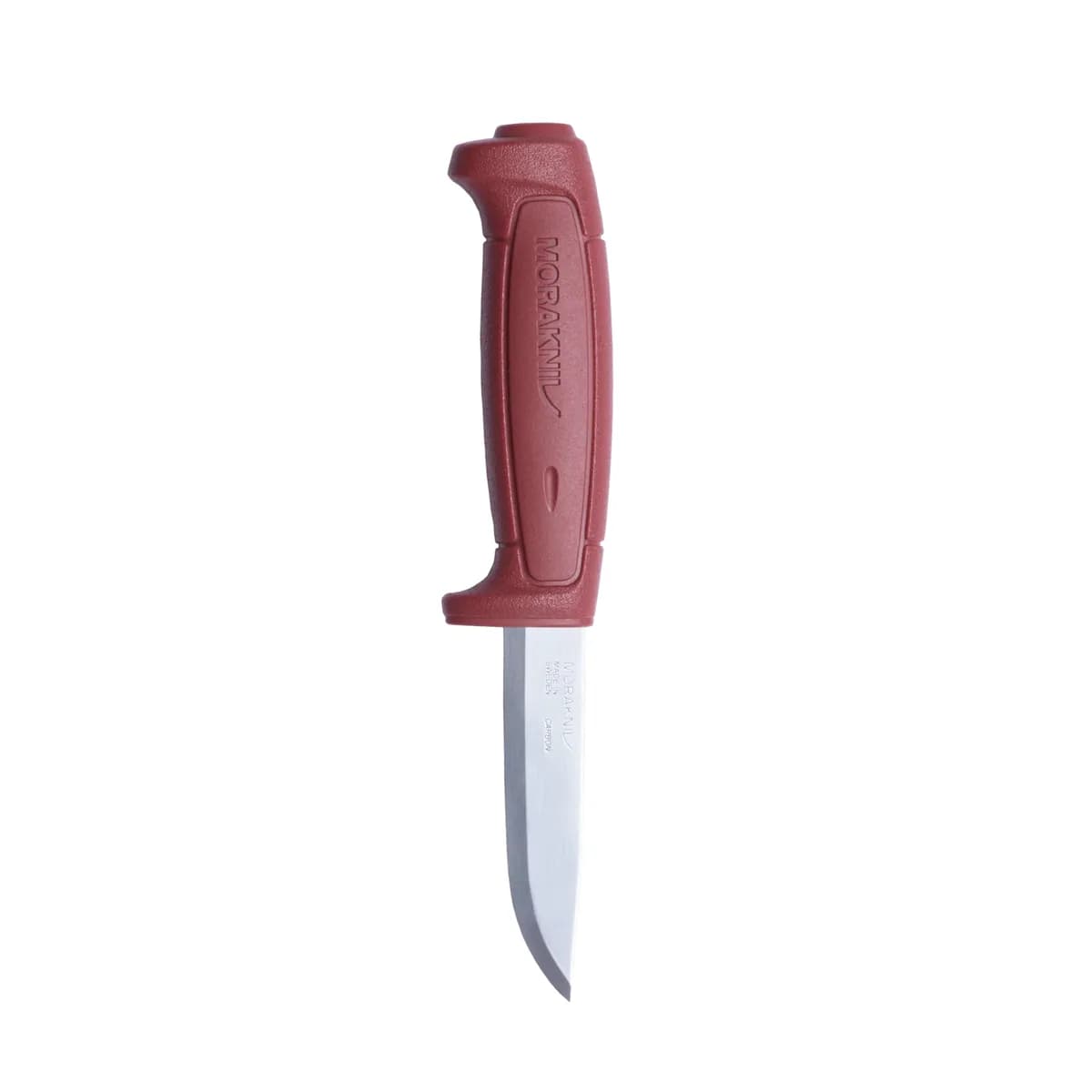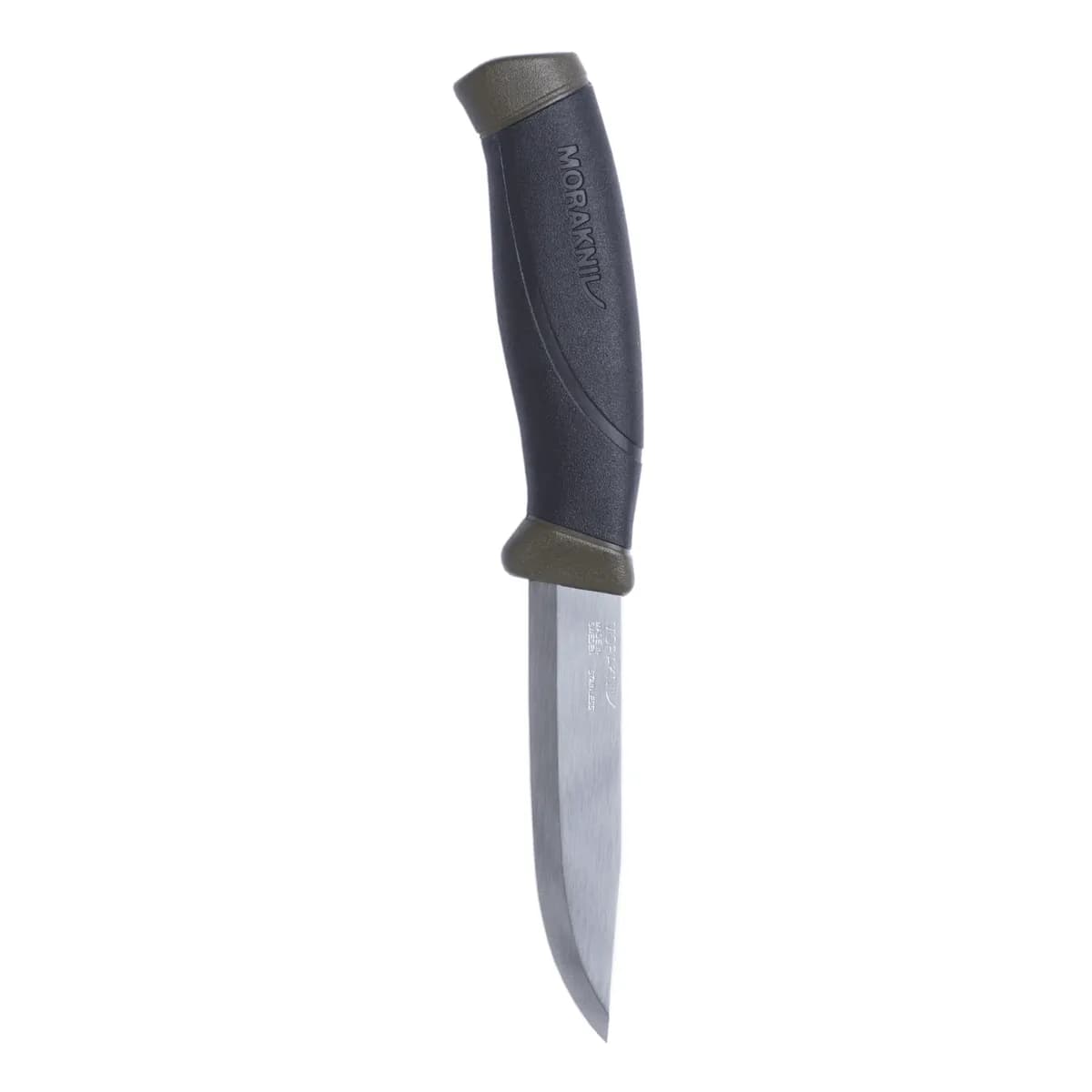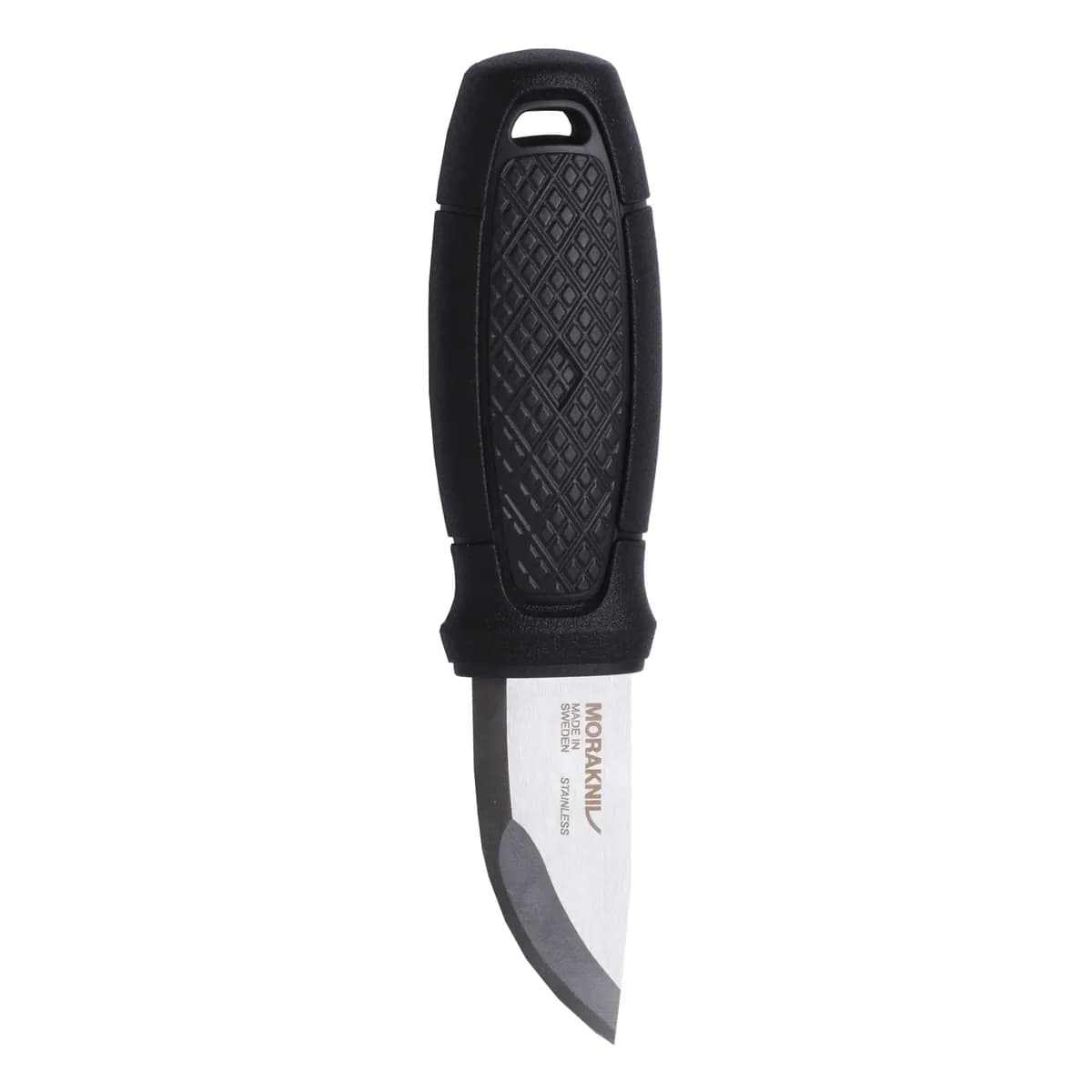
- Morakniv Eldris · Drop Point2.32″ blade · 0.079″ spine · 2.82 oz · ~1.07″ tall
Morakniv Eldris
The Morakniv Eldris is a 2.32" drop point fixed blade in Sandvik 12C27, scandi ground. The handle is Polypropylene. Its spine is 0.079" against a 0.158" median for bushcraft and camp knives here, so it slices better than most and tolerates less abuse.
- Blade
- 2.32″
- Weight
- 2.82 oz
- Steel
- Sandvik 12C27
- Price band
- Budget
Camp cutting and light carving
We may earn a commission. Price and availability on Amazon’s site may differ.
Specifications
Manufacturer-published figures, cross-checked against morakniv.com, knifecenter.
- Blade length
- 2.32″
- Spine thickness
- 0.079″
- Blade shape
- Drop Point
- Grind
- Profile-ground Scandi
- Steel
- Sandvik 12C27
- Overall length
- 5.71″
- Weight
- 2.82 oz
- Lock
- Fixed
- Handle material
- Polypropylene
- Country of origin
- Sweden
Why a drop point
The default hunting and EDC shape, and the safest general answer. The spine curves down to the tip in a convex line, which keeps the point low and strong and leaves plenty of belly for skinning. It is hard to make a drop point bad at anything.
Every drop point here →About Sandvik 12C27
Morakniv and Opinel's steel. Modest edge retention, excellent toughness and grain, sharpens on anything including a river rock.
1-5 is a relative ranking drawn from published composition and hardness, not a lab measurement. Higher is better on every axis, and no steel is a 5 across the board — edge retention and toughness pull against each other. All Sandvik 12C27 knives
What owners say
Drawn from 60 owner discussions of the Morakniv Eldris since 2024. The opinions are theirs. The specifications above come from the maker.
What owners like
- The 2.32 in blade is a natural carver: one owner of both it and the Izula II calls it a great little carver, another owner of both calls it a way better carver than the Izula II, one owner says it works great as a carving tool, and it is said to tire the hand less on small, fine work.
- The fat handle makes a tiny blade usable: one owner of three says it feels better in the hand than an Izula II, an owner with a favorite Kansbol handle calls the Eldris ergonomics as good as it gets for a neck knife, and an older owner appreciates the close thumb control.
- Some owners carry it every day: one keeps it in a jeans pocket or on the neck as an EDC, another says this first fixed-blade EDC will not leave the pocket for quite some time, and a couple each wear one around the neck when camping.
- The squared spine on the standard Eldris throws sparks: one owner says it works great with a ferro rod, another discovered the spine was made for a fire steel, and one owner's son with weak hands uses it with a ferro rod.
- The 12C27 stainless shrugs off neglect: one owner left it out in the rain beside a TOPS Brakimo and an Izula, and the Eldris was the only one with zero rust.
- It is a favorite first knife for children: one owner of three calls it an excellent kids knife because of the handle, an outdoor-skills teacher says it suits smaller hands, and one parent gave Eldrises to the kids on their first backpacking trips.
- The sheath doubles as a handle extension: owners snap the handle into the sheath with the blade facing out to get a normal-length grip, which one owner found more comfortable and another took a week to discover.
- Edge holding is respectable for the size: one owner's rope-cutting comparison found a Kizer in 3V managed only one more cut than an Eldris.
What owners flag
- It is chunky for a neck knife: one owner calls it bulky as a necker and rarely uses it, another calls it a little bulky, and one owner says it is very thick and doubts it would make a good boot knife.
- The short blade limits food work: one owner says it is a little short to slice a sandwich, another does not reach for it for food prep, and one wishes the blade had less belly given how short it is.
- Some end up unused: one owner has hardly used theirs because neck carry is illegal where they live, another bought one cheaply and it sits in a drawer, and one keeps a never-used one in a bag.
- It costs more than bigger Moras: one owner notes it is more expensive than some full-length models, and another points out a Companion Heavy Duty and a Basic 546 together cost about the same as one Eldris.
- The sheath's hold is not for everyone: one owner who compared it with an Odenwolf W-Mini found the Eldris sheath lacking retention, though another owner found the Eldris sheath fine where a 511's was not.
- Not every Eldris has the fire spine: one owner of two says the newer one has a rounded spine, and the gray Light Duty version is identified as the one without the squared spine or the thinned tip.
A 2.32 in blade on a full-size handle is what makes the Eldris, and owners use it as a neck knife, a pocket EDC, a whittler and a fire-starting tool. Two carry it daily, one couple each wears one around the neck when camping, and an outdoor-skills teacher recommends it for smaller hands while one parent gave Eldrises to the kids on their first backpacking trips.
In practice, owners praise how well it carves and how much control the thick handle gives, and the squared spine on the standard model works with a ferro rod. The 12C27 stainless came through being left out in the rain with no rust for one owner. The downsides are the ones size implies: it is bulky for a necker, too short for slicing a sandwich, and three owners admit theirs mostly sits unused. Buyers should note that the gray Light Duty version lacks the fire-steel spine.
The Izula II is the knife owners compare it with most. Owners of both find the Eldris the better carver with the better handle and lighter on the neck, while the Izula is flatter, larger and sturdier. One owner pairs it with a bigger Mora, and another calls it a champ at fire prep with a good fire steel.
Is the Eldris good as a neck knife?
Owners who wear it say yes: one couple each wears one when camping, one owner wears it on a neck cord as an EDC, and another says the larger Izula would be no upgrade as a neck knife. One owner finds it bulky as a necker and rarely uses it.
Should I get an Eldris or an ESEE Izula II?
Owners of both mostly prefer the Eldris for carving and comfort: one says the Izula II has a hot spot in the finger groove and a geometry too fat for carving, and another prefers the Eldris handle though it is bulkier. The Izula is larger, heavier and flatter, which one owner rates as sturdier and more versatile.
Does the Eldris spine strike a ferro rod?
The standard Eldris has a squared spine that owners use with ferro rods and fire steels. One owner of two says the newer one has a rounded spine, and the gray Light Duty model is identified as the one without the fire-steel spine.
Isn't the handle too short to hold properly?
The grip can be extended by snapping the handle into the sheath with the blade facing out, so the sheath forms the back of the grip. One owner says it is much more comfortable that way, and another only figured the trick out after a week.
Is the Eldris a good knife for a child?
Owners who teach or have children say so. One owner of three calls it an excellent kids knife because of the handle, an outdoor-skills teacher for ages 6 to 14 says it suits smaller hands, and one parent gave them to the kids on their first backpacking trips.
Features
- Full fixed tang
- Scandi grind
- Made in Sweden
- Stainless blade
Compare the Eldris
Related knives
More from Morakniv →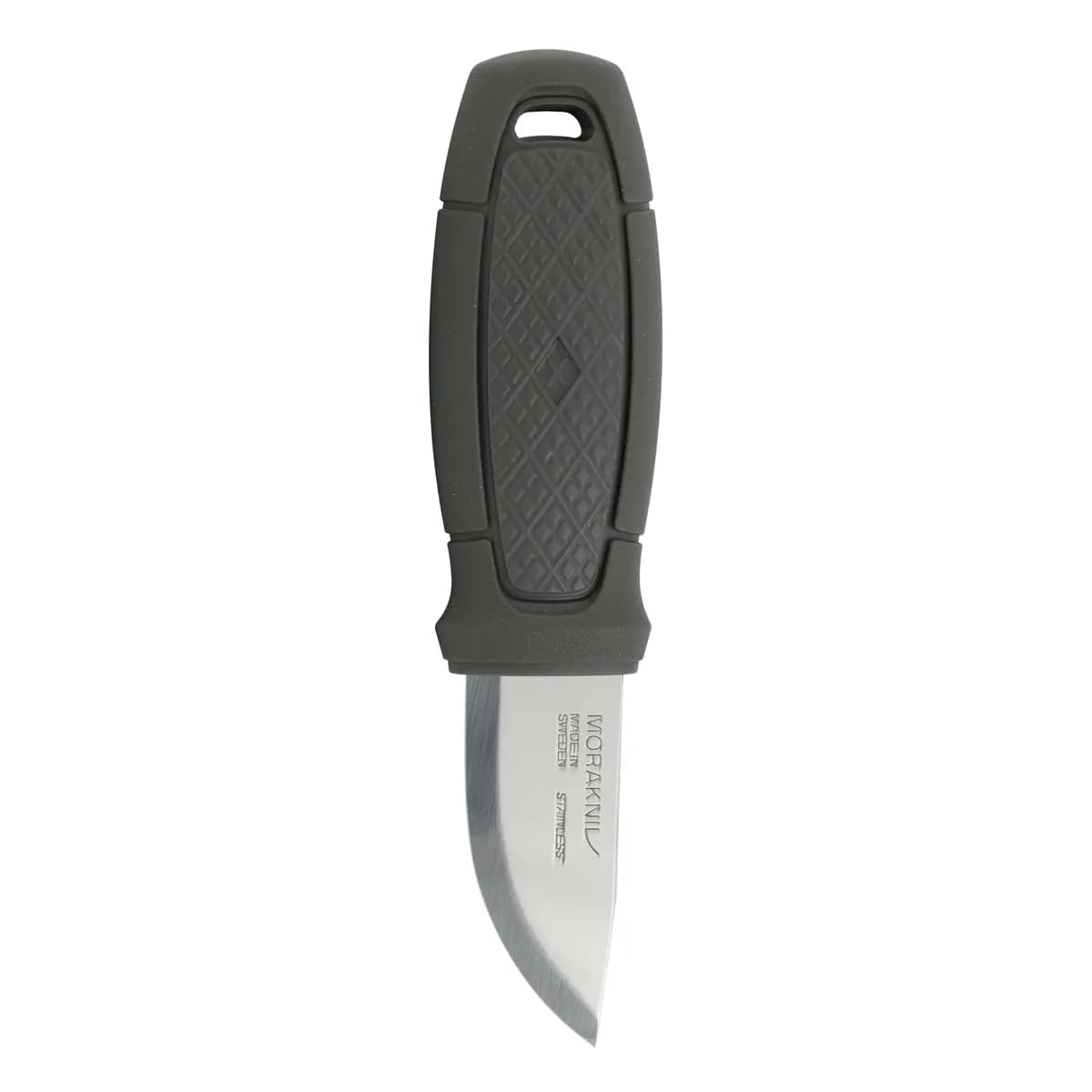
Morakniv Eldris LightDuty
- Blade
- 2.3″
- Weight
- 2.78 oz