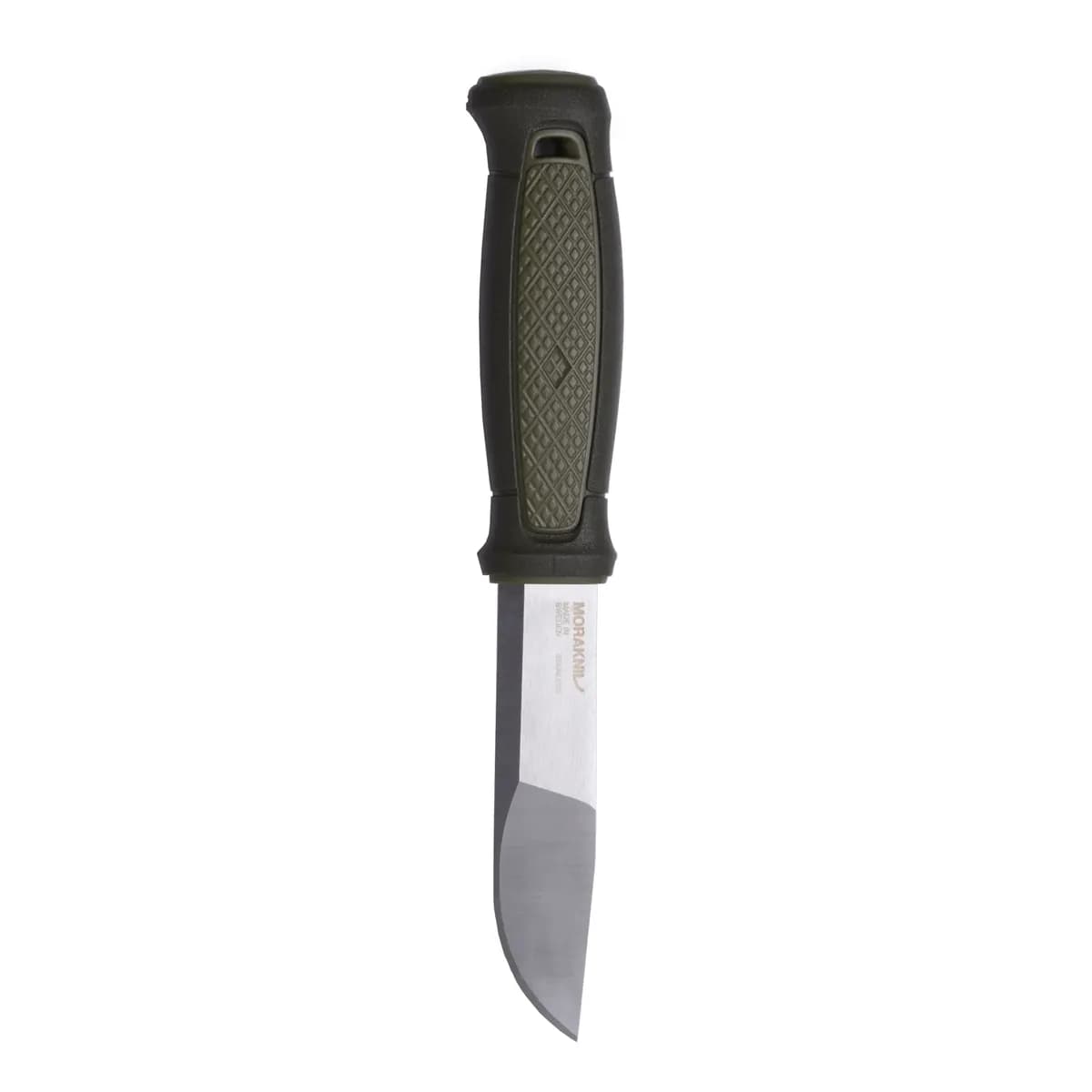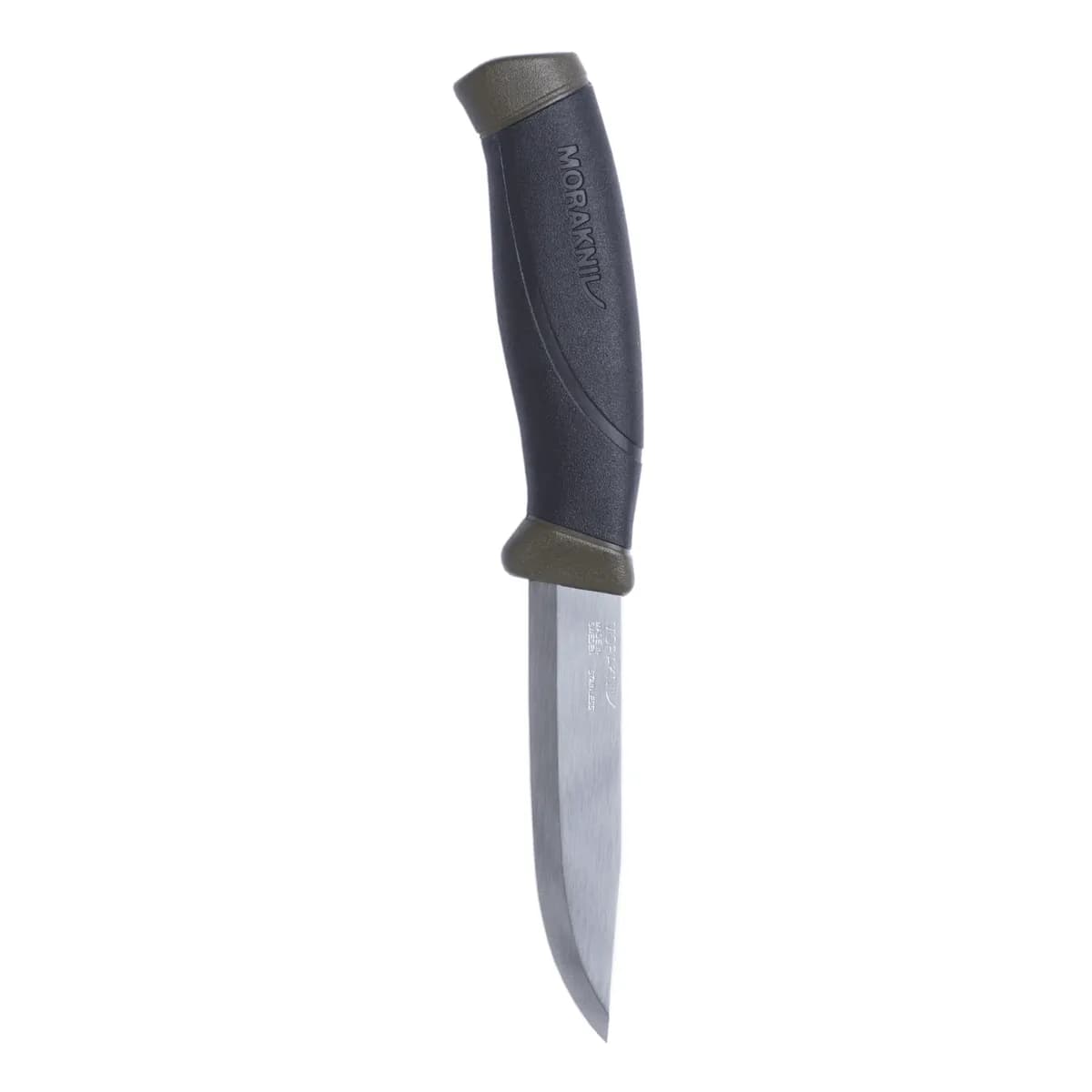
- Morakniv Companion · Drop Point4.09″ blade · 0.079″ spine · 4.18 oz · ~0.93″ tall
Morakniv Companion
The Morakniv Companion is a 4.09" drop point fixed blade in Sandvik 12C27, scandi ground. The handle is TPE. Its spine is 0.079" against a 0.158" median for bushcraft and camp knives here, so it slices better than most and tolerates less abuse.
- Blade
- 4.09″
- Weight
- 4.18 oz
- Steel
- Sandvik 12C27
- Price band
- Budget
Batoning, carving and fire prep
We may earn a commission. Price and availability on Amazon’s site may differ.
Specifications
Manufacturer-published figures, cross-checked against morakniv.com.
- Blade length
- 4.09″
- Spine thickness
- 0.079″
- Blade shape
- Drop Point
- Grind
- Scandi
- Steel
- Sandvik 12C27
- Overall length
- 8.5″
- Weight
- 4.18 oz
- Lock
- Fixed
- Country of origin
- Sweden
Note on weight: published figure includes sheath.
Why a drop point
The default hunting and EDC shape, and the safest general answer. The spine curves down to the tip in a convex line, which keeps the point low and strong and leaves plenty of belly for skinning. It is hard to make a drop point bad at anything.
Every drop point here →About Sandvik 12C27
Morakniv and Opinel's steel. Modest edge retention, excellent toughness and grain, sharpens on anything including a river rock.
1-5 is a relative ranking drawn from published composition and hardness, not a lab measurement. Higher is better on every axis, and no steel is a 5 across the board — edge retention and toughness pull against each other. All Sandvik 12C27 knives
What owners say
Drawn from 253 owner discussions of the Morakniv Companion since 2024. The opinions are theirs. The specifications above come from the maker.
What owners like
- Buyers report paying very little for it: one UK owner got a stainless Companion for £9.95 in 2025, another paid €15 for a first bushcraft knife that year, and a Canadian owner paid $27.95 CAD in 2026.
- Owners report long service: one has carried the same stainless Companion hiking and camping for more than five years without wanting anything bigger, another has used one for going on a decade on kindling, camp food and gardening, and one owner who uses two dozen for bushcraft courses says they have held up through a decade of use and abuse.
- It arrives sharp: one owner calls the Companion among the sharpest knives out of the box they have owned, and a new buyer says the blade came sharp with a great finish.
- The 12C27 stainless version is close to maintenance-free for wet work; one owner who kept handling the knife with wet hands says the stainless Companion could be left wet for days without worry, and another keeps stainless ones in every car glovebox and the camper to keep them rust free.
- Scandi sharpening is approachable: one amateur got a uniform, surprisingly sharp edge on a 400 grit whetstone followed by stropping, and the advice given is to lay the wide bevel flat on the stone rather than reach for a guided system.
- The stock plastic sheath gets real praise: one buyer likes how tightly it holds the knife while leaving room around the blade, one owner rates Mora sheaths above Kydex from custom makers, and another calls the original sheath one of the most functional on the market in cold or wet weather.
- Owners use it on game and in camp: one has used a Companion for three seasons and says it cuts through whitetail sternum, and another processed a buck with a regular Companion the second day of owning it.
- The handle draws ergonomic praise: one owner of custom-scaled fixed blades says the Companion feels nearly perfect in the hand, and a new buyer found the handle comfortable and sturdy.
What owners flag
- It throws poor sparks off a ferro rod as shipped: one new owner had more luck striking with the household spatula, another called the spine bordering on acceptable and sanded it to a crisp 90 degrees, and one owner moved on to another knife as a fire striker for that reason.
- The first sharpening takes extra work: one owner needed a magnifying glass to spot the factory micro-bevel, and two others found their Moras had a slight hollow in the scandi bevel that took a while to grind out.
- Hard use can damage the tip and edge: one owner snapped a few millimetres off the tip batoning on stone (the only damage since 2017, ground back on a belt grinder), and another rolled the tip popping holes in beer cans and the edge batoning through chicken legs.
- The 12C27 edge and tip divide owners: one says stainless Moras deform and lose tips more readily than carbon in their own twisting and prying tests, while another points to toughness data favoring the stainless.
- A dropped Companion can be hard to find: one owner's green Companion, fitted with orange paracord, sat lost in the forest for a full year, and two other owners chose bright handles so a dropped knife is easier to spot.
- The handle does not suit everyone: one owner's partner, who uses the Companion as a kitchen knife, finds the handle too big for a comfortable grip, and a puukko user calls the Companion's handle restrictive because of the guard.
Going on a decade of kindling, camp food and gardening is how one owner sums up a Companion. At 4.09 in of scandi-ground Sandvik 12C27 on a TPE handle, it is a common first fixed blade, a spare one owner keeps in every car glovebox, and the knife one bushcraft course runs two dozen of. Buyers report paying roughly £10 to $28 CAD, and the low price is part of why owners say they use it without hesitation.
Out of the box it is sharp and the sheath holds it well, and the stainless version shrugs off being left wet. Ferro rod striking is the repeated complaint: as shipped the spine sparks poorly, and one owner sanded it square to fix that. The factory micro-bevel and a slight hollow in the bevel make the first full sharpening slower. Owners baton with it inside the blade length and away from knots, and the damage reports come from hitting stone, punching cans or deliberate prying tests.
The Kansbol, Garberg and Companion Heavy Duty are the knives owners weigh against it. One owner calls the Kansbol a lateral move that performs much like the Companion, while a Garberg buyer found that knife far more substantial; one owner of both prefers the standard Companion over the Heavy Duty for food prep and whittling. One owner of a full-tang BPS calls it very close to a Companion killer, and BPS comes up as the full-tang alternative at a similar price.
Is the Companion strong enough to baton wood with its partial tang?
Two owners of the standard Companion report batoning with it, keeping the wood no wider than the blade and away from hard knots. One owner who has had a Companion since 2017 broke a few millimetres off the tip only when the blade hit stone, and another has never broken one. An axe or hatchet is suggested for anything beyond straight-grained kindling.
Will the Companion's spine strike a ferro rod?
Not well as shipped. One new owner got better sparks from a spatula. A hand file squares the spine in a few passes, and one owner who sanded it to 90 degrees says it now strikes as well as any. Another owner stopped using it as a fire striker.
How do I sharpen the Companion's scandi edge?
The advice is to lay the wide bevel flat on the stone and work until the small factory micro-bevel and any slight hollow are gone, which took one owner a while the first time. One amateur got a surprisingly sharp, even edge on a 400 grit stone followed by stropping. One owner instead convexes the edge on sandpaper over a mouse pad.
Should I buy the stainless or carbon Companion?
One owner with both says the carbon holds an edge slightly longer and takes a finer one, but the stainless will not rust if they forget to oil it. Another owner who often works with wet hands made the stainless their most used knife for that reason. Owners also argue over toughness, with one citing data that favors the stainless and another reporting the opposite from their own tests.
My new stainless Companion looks shinier than expected. Is it fake?
Two owners who looked at one buyer's photos said the bright, almost mirror finish is normal on stainless Companions, and one said it looked exactly like the one they bought two years earlier. One owner suggested measuring blade thickness with calipers, since the buyer may simply have received a standard Companion instead of the Heavy Duty, while another thought it was either a very old model or a counterfeit and pointed to the counterfeit guide on Morakniv's website.
Is a Garberg or Kansbol worth it over the Companion?
Owners are split. One calls the Kansbol a lateral move that performs almost the same as the Companion, while one Garberg buyer found it significantly more substantial and confidence-inspiring for hard bushcraft work. Another suggests simply buying a backup Companion if the current one is doing everything you need.
Features
- Full fixed tang
- Scandi grind
- Made in Sweden
- Stainless blade
Compare the Companion
Related knives
More from Morakniv →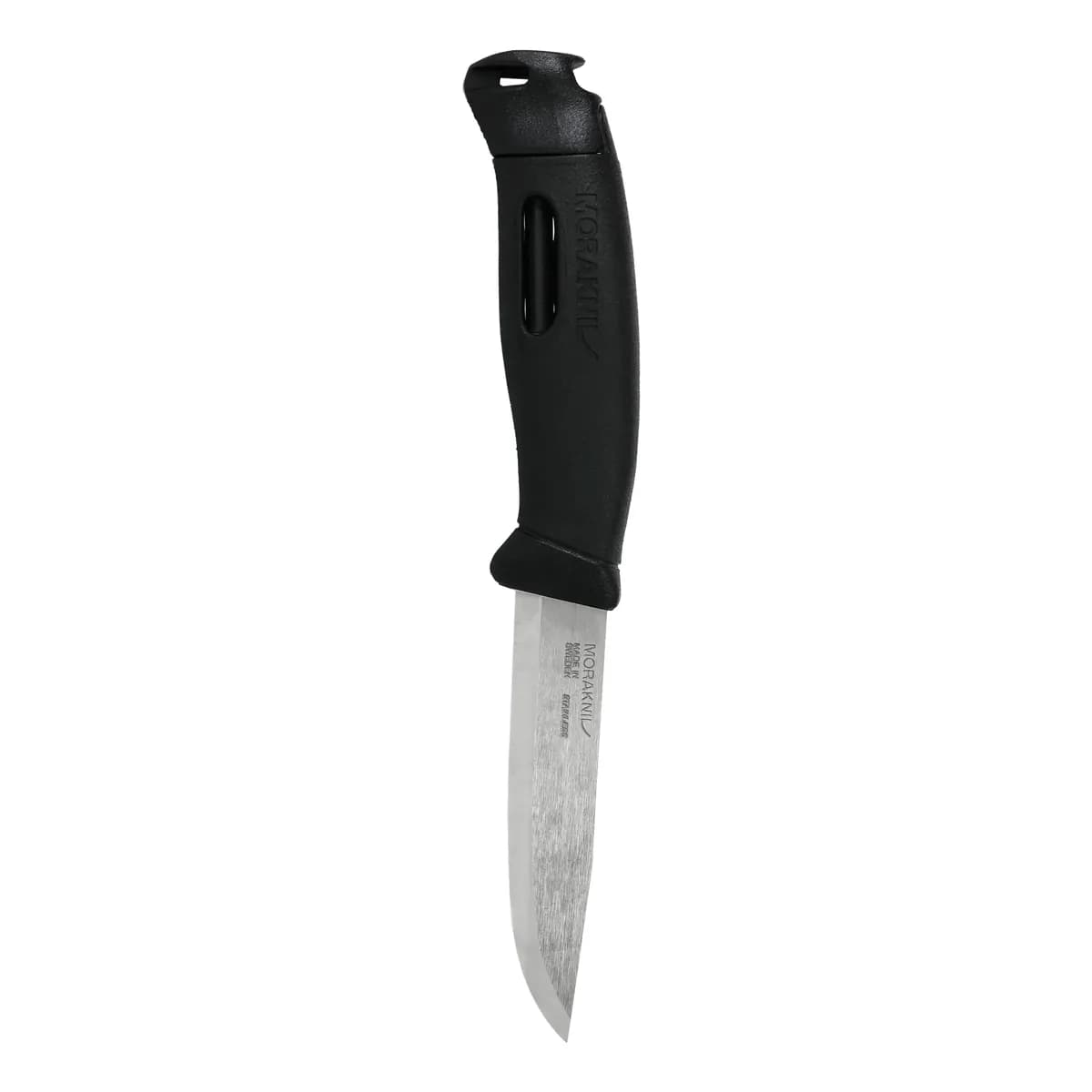
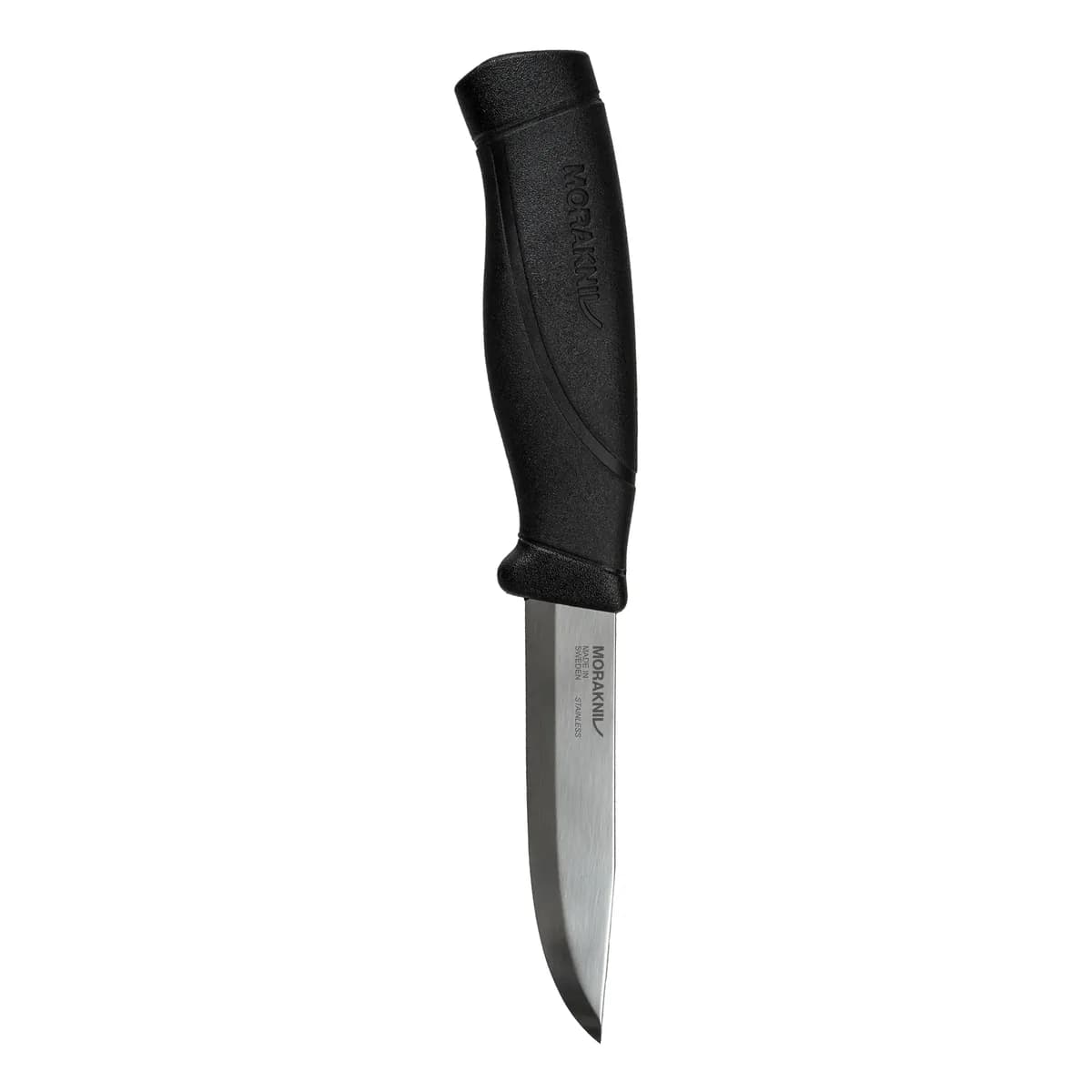
Morakniv Companion Heavy Duty
- Blade
- 4.1″
- Weight
- 4.77 oz