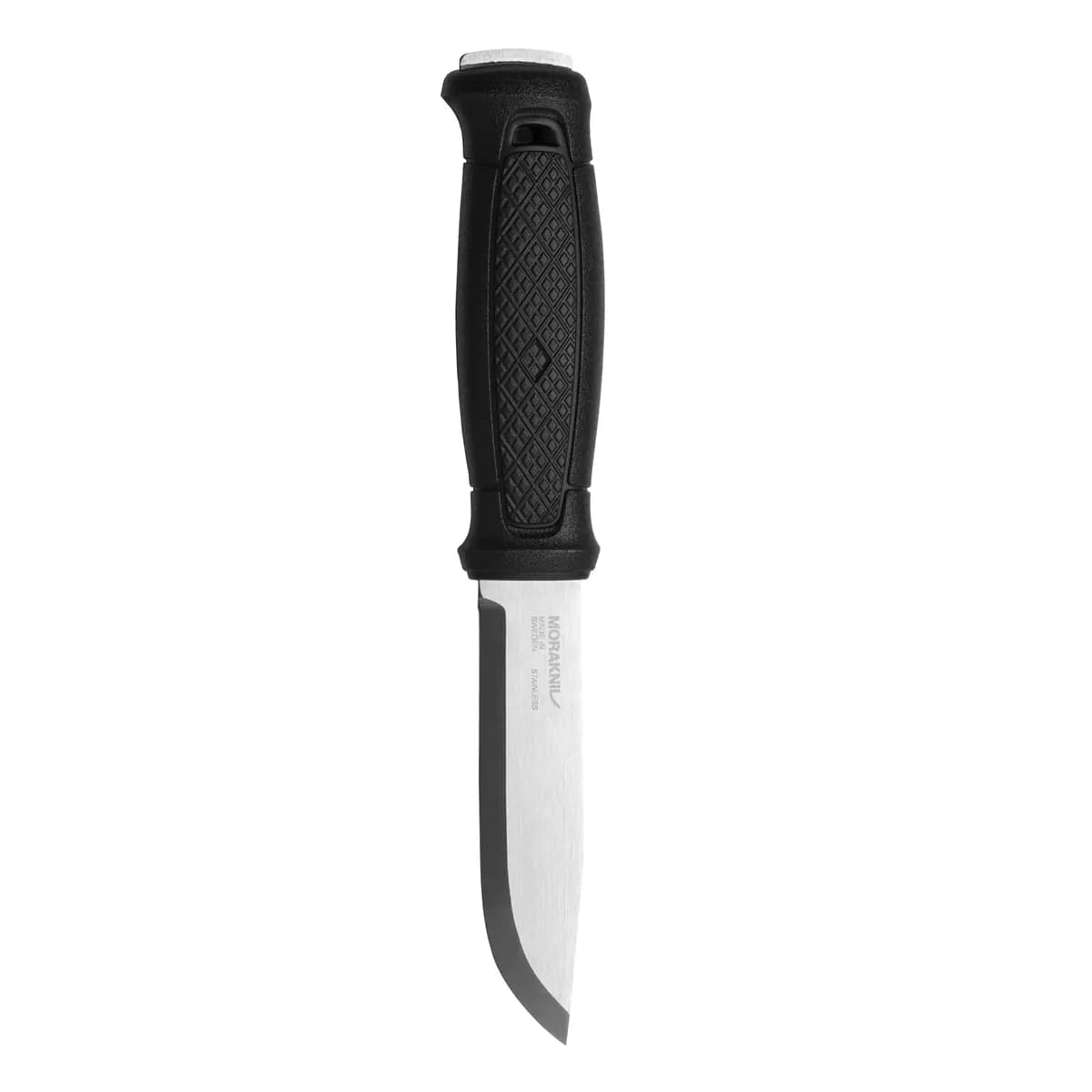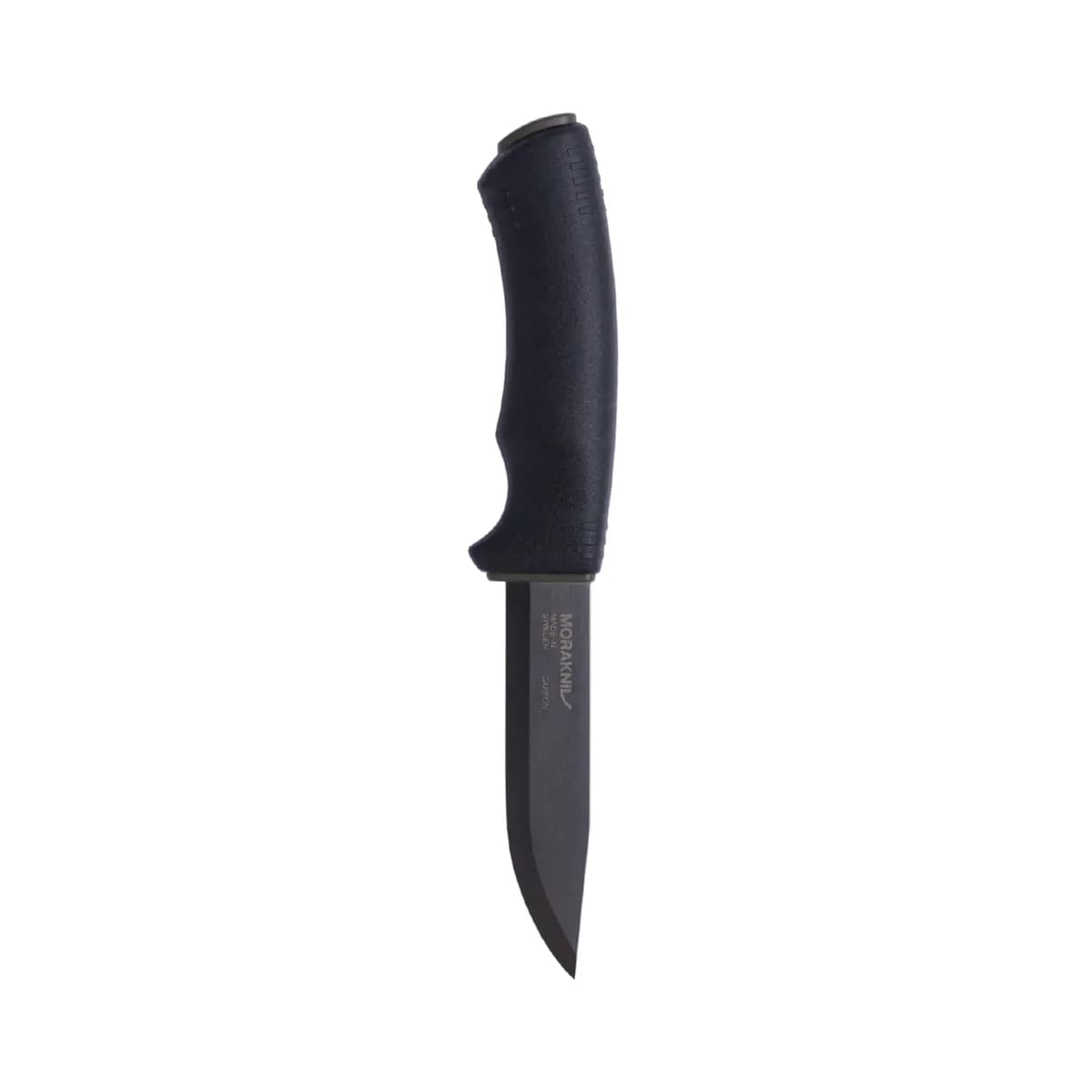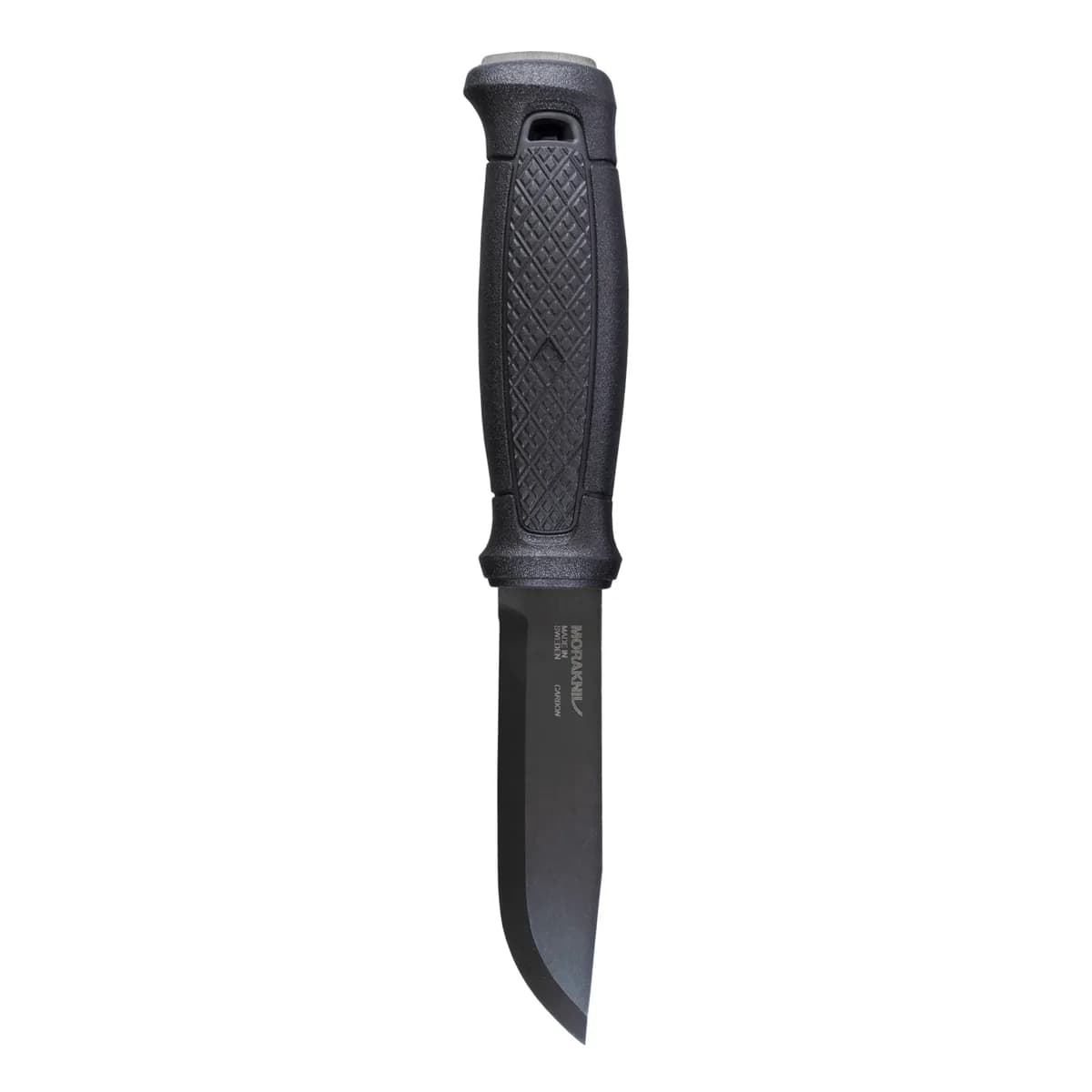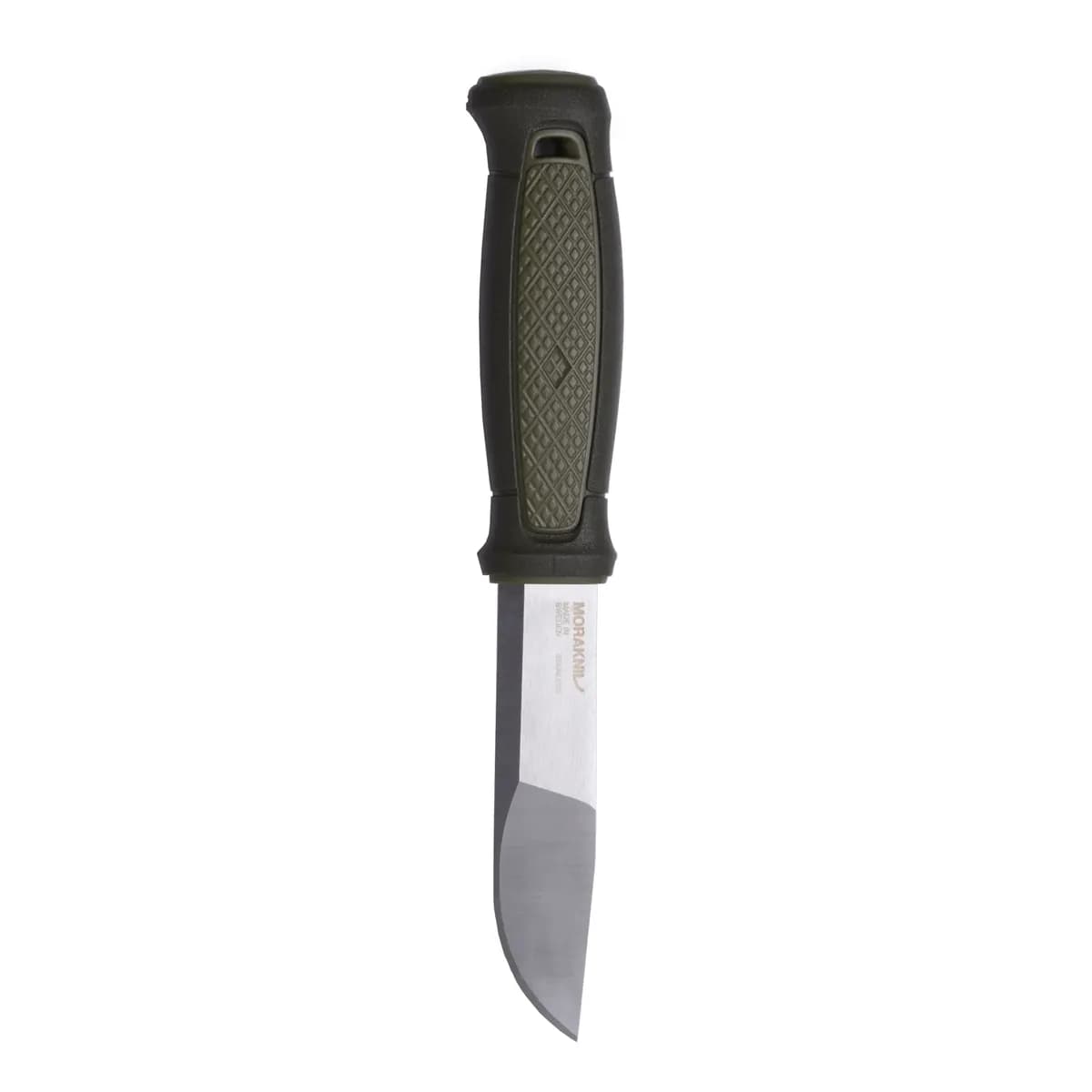
- Morakniv Kansbol · Drop Point4.25″ blade · 0.098″ spine · 4.73 oz · ~1.14″ tall
Morakniv Kansbol
The Morakniv Kansbol is a 4.25" drop point fixed blade in Sandvik 12C27, profile-ground scandi ground. The handle is TPE. Its spine is 0.098" against a 0.158" median for bushcraft and camp knives here, so it slices better than most and tolerates less abuse.
- Blade
- 4.25″
- Weight
- 4.73 oz
- Steel
- Sandvik 12C27
- Price band
- Budget
Batoning, carving and fire prep
We may earn a commission. Price and availability on Amazon’s site may differ.
Specifications
Manufacturer-published figures, cross-checked against morakniv.com, knifecenter.
- Blade length
- 4.25″
- Spine thickness
- 0.098″
- Blade shape
- Drop Point
- Grind
- Profile-ground Scandi
- Steel
- Sandvik 12C27
- Overall length
- 8.86″
- Weight
- 4.73 oz
- Lock
- Fixed
- Country of origin
- Sweden
Why a drop point
The default hunting and EDC shape, and the safest general answer. The spine curves down to the tip in a convex line, which keeps the point low and strong and leaves plenty of belly for skinning. It is hard to make a drop point bad at anything.
Every drop point here →About Sandvik 12C27
Morakniv and Opinel's steel. Modest edge retention, excellent toughness and grain, sharpens on anything including a river rock.
1-5 is a relative ranking drawn from published composition and hardness, not a lab measurement. Higher is better on every axis, and no steel is a 5 across the board — edge retention and toughness pull against each other. All Sandvik 12C27 knives
What owners say
Drawn from 74 owner discussions of the Morakniv Kansbol since 2024. The opinions are theirs. The specifications above come from the maker.
What owners like
- The thin, tapered front of the blade makes it a Mora for food: one owner of two loves it for food prep, another keeps one dedicated to it, a collector kept it for the food-prep role after adding a Garberg, and it is called noticeably better than the Companion at food prep and skinning game.
- Carving is a strength despite the slimmer blade: one person finds it a far better carver than the Garberg, an owner of several Moras says the forward curve works like a chisel for feather sticks while the narrow tip handles fine cuts, and a third calls it a go-to crafting knife.
- The handle wins converts: one owner calls it the favorite handle on any knife they own, another prefers it to the Companion's, and one person who flags its limits still calls the grip very comfortable.
- Sheath retention is rated highly: one owner calls it excellent, another says the round sheaths on the Kansbol, Eldris and Garberg all hold well, and it is rated a bit better than the Companion's.
- Owners keep it on them daily: one has worn it on the belt every day and gave away pricier fixed blades, another calls it the best everyday knife they own, and a third keeps it in a work tool bag.
- Light batoning goes fine for some owners: one batons with it all the time without the edge rolling, another loves it for batoning on long hikes because of its weight and says a friend has done the same for a year longer, and a third batons only wood no wider than the scandi section.
- The square spine is ready for a ferro rod and for scraping tinder out of the box, which counts among its advantages over the Companion.
- Prices paid stay modest: one buyer paid $30 in 2025, another paid 16 euros at the Mora outlet in Nusnäs in 2024, and a Canadian owner of two averaged 65 to 70 CAD.
What owners flag
- The thin tip does not take sideways force: it is called very delicate and not built for prying, and an owner of the Mora 2000, which uses the same blade, chipped it easily in hard woods and found it fragile next to a Companion HD.
- The 12C27 edge dulls and rolls for some users: one owner says theirs rolls badly and dulls so often that hand sharpening became a learned skill, and another finds it dulls faster than a carbon Bushcraft Black.
- The two-thickness edge is harder to maintain away from home; one owner who otherwise rates it for food prep says sharpening the changing edge in the field is a pain.
- It costs roughly twice a Companion, and owners disagree that it earns it: one calls it a lateral move that performs almost the same, while another says it does nothing wildly different from a Companion apart from processing game.
- The partial rubber on the handle does not suit every hand: one owner finds the Companion's all-TPE grip more pleasant over long use, and another says the Bushcraft Forest version with the softer Bushcraft handle is better.
Food prep and fine carving are what owners use the Kansbol for. Its 4.25 in Sandvik 12C27 blade starts as a scandi near the handle and thins toward a narrow tip, and owners describe it as the Mora they reach for to slice food, skin game or carve feather sticks, with one keeping it on the belt every day. The square spine for a ferro rod and a well-liked handle and sheath round out why owners pay more than a Companion.
That thin tip is also the main caution. It is called delicate under prying and sideways pressure, an owner of the Mora 2000 (same blade) chipped it in hard woods, and one owner's edge rolls and dulls quickly enough to need frequent sharpening. Batoning reports are mixed rather than bad: two owners baton with it regularly, while one keeps it to wood no wider than the scandi section.
The Companion and the Garberg are the knives owners weigh it against. Two owners rate the Kansbol above the Garberg as a carving and all-purpose knife, one finding the Garberg only alright for the money, while one Garberg owner says that knife is not even fazed by heavy beating. Against the Companion, opinion splits between calling it a real step up for food and game and calling it a lateral move.
Is the Kansbol worth twice the price of a Companion?
It depends on the job. One view holds it is noticeably better than the Companion at food prep and much better for processing game, with a better handle and sheath. Another calls it a lateral move that performs almost the same, and one notes it does nothing wildly different from a Companion outside game processing.
Can I baton wood with the Kansbol?
Some owners do: one batons with it all the time without edge rolling, and another praises it for batoning on long hikes. One owner limits it to wood no wider than the scandi part of the blade. The narrow tip is called delicate under prying and sideways force.
Is the Kansbol good for carving or only for food?
Owners use it for both. One finds it a much better carving knife than the Garberg, and another uses the curve near the tip like a chisel for feather sticks. One owner keeps it strictly for food prep and carves with a Bushcraft Black instead.
How well does the Kansbol hold an edge?
Reports vary. One owner says the edge rolls and dulls often, and another finds it dulls faster than a carbon Bushcraft Black, though carrying a sharpener makes that a moot point. One owner adds that the changing edge thickness makes field sharpening a pain.
How secure is the Kansbol's sheath?
Retention is rated highly: one owner calls it excellent, and another says the round sheaths of the Kansbol, Eldris and Garberg all hold well. It is also rated a little better than the Companion's sheath.
Features
- Full fixed tang
- Profile-ground Scandi grind
- Made in Sweden
- Stainless blade
Compare the Kansbol
Related knives
More from Morakniv →