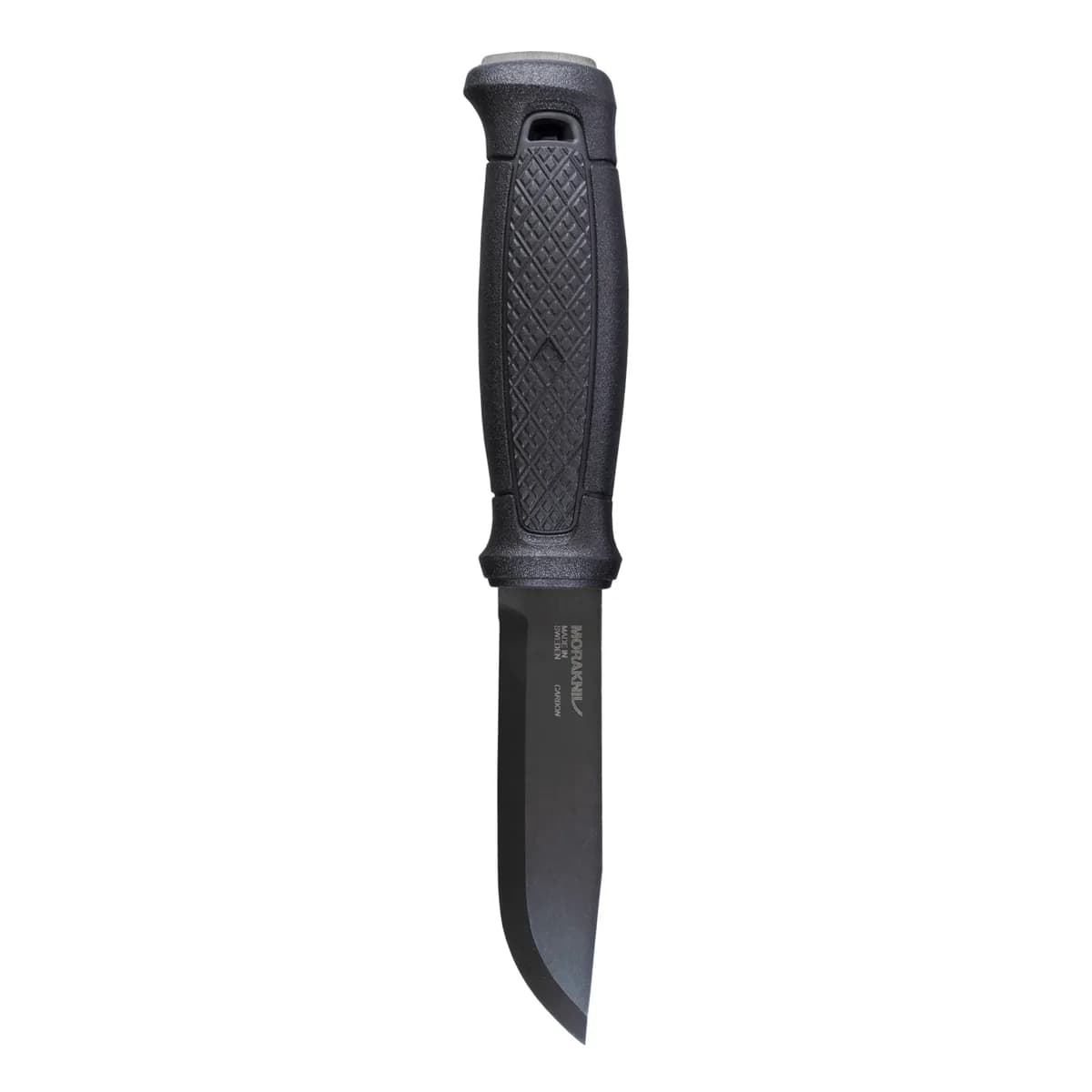
- Morakniv Garberg Carbon · Drop Point4.3″ blade · 0.13″ spine · 7.3 oz · ~1.19″ tall
Morakniv Garberg Carbon
The full-tang Garberg in C100S carbon rather than Sandvik 14C28N, with a black coating on the blade that is corrosion protection rather than decoration. Everything else — the 4.3" scandi grind, the ground spine that throws sparks off a ferro rod, the polyamide handle — is identical. Carbon takes a working edge back faster in the field; stainless survives being put away wet.
- Blade
- 4.3″
- Weight
- 7.3 oz
- Steel
- C100S Carbon
- Price band
- Mid
Bushcraft where you sharpen in the field and dry the blade after
We may earn a commission. Price and availability on Amazon’s site may differ.
Specifications
Manufacturer-published figures, cross-checked against morakniv.com.
- Blade length
- 4.3″
- Spine thickness
- 0.13″
- Blade shape
- Drop Point
- Grind
- Scandi
- Steel
- C100S Carbon
- Weight
- 7.3 oz
- Lock
- Fixed
- Handle material
- Polyamide
- Country of origin
- Sweden
Note on weight: Knife only; about 9.6 oz with the multi-mount sheath.
Why a drop point
The default hunting and EDC shape, and the safest general answer. The spine curves down to the tip in a convex line, which keeps the point low and strong and leaves plenty of belly for skinning. It is hard to make a drop point bad at anything.
Every drop point here →About C100S Carbon
The carbon steel Morakniv uses in the Garberg and Bushcraft lines. Tough enough to baton and easy to bring back with a stone in the field, at the cost of rusting if neglected. The black coating on the blade is corrosion protection, not decoration.
1-5 is a relative ranking drawn from published composition and hardness, not a lab measurement. Higher is better on every axis, and no steel is a 5 across the board — edge retention and toughness pull against each other. All C100S Carbon knives
What owners say
Drawn from 20 owner discussions of the Morakniv Garberg Carbon since 2024. The opinions are theirs. The specifications above come from the maker.
What owners like
- The blade itself outlasts its finish: one owner has used the same carbon Garberg for five years and says the only thing that has changed is the black coating, and a long-time Mora user who runs the DLC version as a main knife says it will last a lifetime with care.
- One owner picked carbon over the 14C28N Garberg for bushcraft abuse: it needs honing a bit more often, but that owner considers it more durable and calls it the go-to beater that takes anything dished out on it.
- It keeps a working edge through camp chores: one owner who carves, batons and cuts rope with it says it is always sharp enough to slice a standing sheet of paper with a pulling cut.
- One electrician moved to it from a budget folder for daily work, paying $120 out the door in 2024; it can be drawn and put away one-handed, it cuts 12 gauge solid copper wire and straps, and that owner says the full tang and pommel allow striking on the spine.
- The factory sheath suits all-day wear for that same owner, who finds it comfortable, likes that the belt loop adjusts for either side, and notes the handle guard sits well inside the sheath so a hand cannot slip onto the edge on the draw.
- Some owners rank it at the top of their Mora collections: one with five Moras calls the carbon Garberg a favorite, and one long-distance hiker carries it, or a carbon ESEE 3, in place of an axe for emergency batoning.
What owners flag
- Taking off the factory micro-bevel is slow: one owner spent more than an hour on a 120 grit ceramic stone without removing it, which is normal for a light ceramic on this carbon steel, and diamond is only somewhat faster.
- The black coating wears with use: the owner who has carried one for five years says the coating is the one part that has changed.
- It needs touching up more often than the stainless version: an owner who chose carbon hones it more, and one view holds that the 14C28N Garberg wins on edge retention and corrosion resistance with similar toughness.
- Not everyone gets on with a full-height scandi grind on stock this thick: one owner had both the carbon and stainless Garbergs and sold both for that reason, moving to a flat-ground Victorinox Venture.
- In one owner's informal test, an unmodified carbon Garberg scored last of four knives across batoning birch, feathersticking and drilling pine, behind a Casstrom, a Benchmade Leuku and the owner's own reground stainless Garberg, though its log had a knot.
Five years of bushcraft use with only the black coating showing wear is how one owner describes a carbon Garberg. It is the same 4.3 in scandi-ground full-tang Garberg as the stainless model, here in C100S carbon at about 0.13 in thick and 7.3 oz, roughly 9.6 oz with the multi-mount sheath. One owner picks it as the beater for bushcraft, another keeps a gifted one in reserve while using a Companion Heavy Duty day to day, and an electrician carries it on the job instead of a folder.
Out of the box the edge is sharp, and one owner found it got sharper still after sharpening and stropping. The first full sharpening is the chore: removing the factory micro-bevel took one owner over an hour on a coarse ceramic stone without finishing. After that, one owner reports it holding a working edge through carving, batoning and rope, though another who chose carbon hones it more often. A stainless Garberg owner expects the DLC coating to make rust almost a non-issue but suggests a light oil after use anyway.
The stainless 14C28N Garberg is the knife it is most often weighed against, and one view holds that steel wins on edge retention and corrosion while toughness is close. One owner alternates it with a carbon ESEE 3, another would buy an ESEE 4 or 6 if limited to a single knife, and one owner who disliked a scandi grind on thick stock sold both Garbergs for a Victorinox Venture.
Is it normal for the Garberg Carbon's micro-bevel to take ages to grind off?
Yes. One owner spent over an hour on 120 grit ceramic without removing it, and that is normal for a light ceramic stone on this carbon steel. A diamond plate at the same grit is faster, though not by a lot. Starting coarse and stepping finer is the advice.
Should I get the Garberg in carbon or 14C28N stainless?
One owner chose carbon as more durable for bushcraft abuse, accepting more frequent honing, and calls the carbon Garberg the go-to beater that takes anything. The opposing view holds that the 14C28N version holds an edge longer, resists corrosion better and takes a finer edge, with toughness about the same. One owner who tried both sold them, because the complaint was the thick scandi grind rather than the steel.
Does the coated carbon Garberg still need oiling?
A stainless Garberg owner suggested lightly oiling it after use but expects the DLC coating makes rust almost a non-issue. One carbon owner who has used one for five years says the only change in that time is wear to the coating, and suggests cleaning tools after use makes the difference.
Which pocket sharpener works for touching up the Garberg Carbon in the field?
For a Garberg used for carving, batoning and cutting rope, the diamond pocket stone is favored over the ceramic one: it works out a rolled edge or small chip much faster in the field and is easier to clear of swarf on a trip. A guided field sharpener is suggested as easier for anyone not yet good at holding an angle.
Features
- Full fixed tang
- Scandi grind
- Made in Sweden
- Carbon steel blade — will patina
Compare the Carbon
Related knives
More from Morakniv →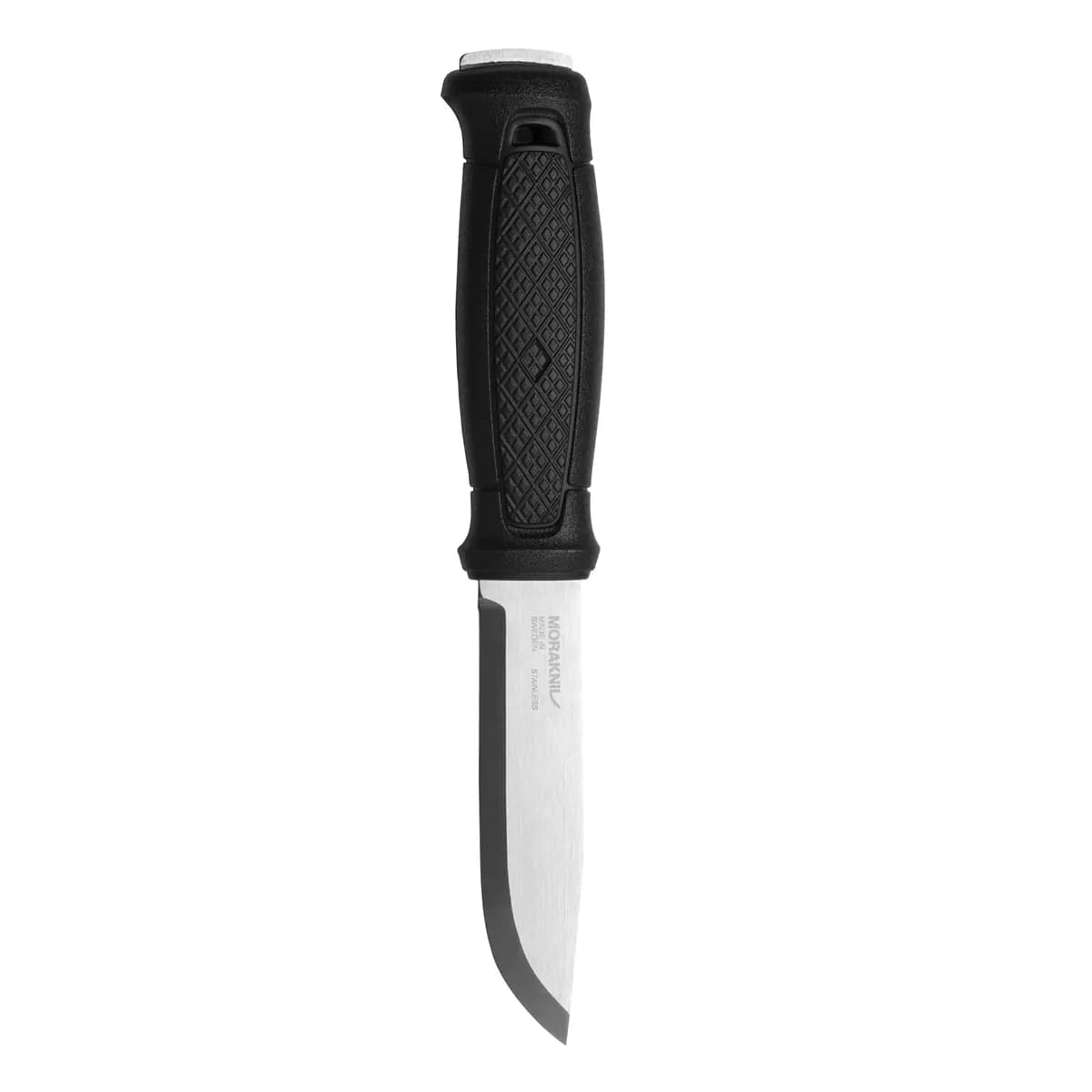
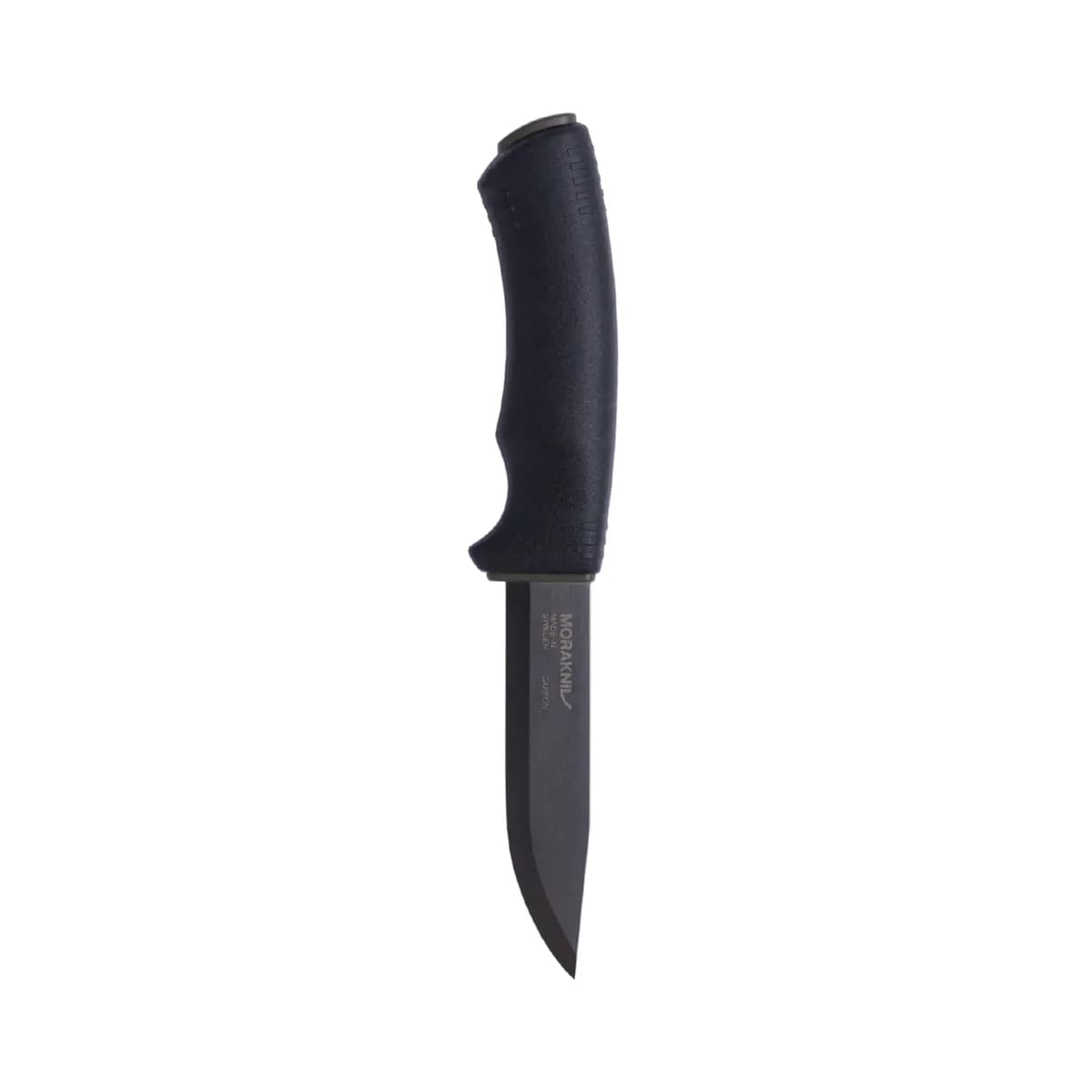
Morakniv Bushcraft Hi-Vis
- Blade
- 4.3″
- Weight
- 5.71 oz