- Spyderco Manix 2 Lightweight · Drop Point3.37″ blade · 0.125″ spine · 3 oz · ~1.36″ tall
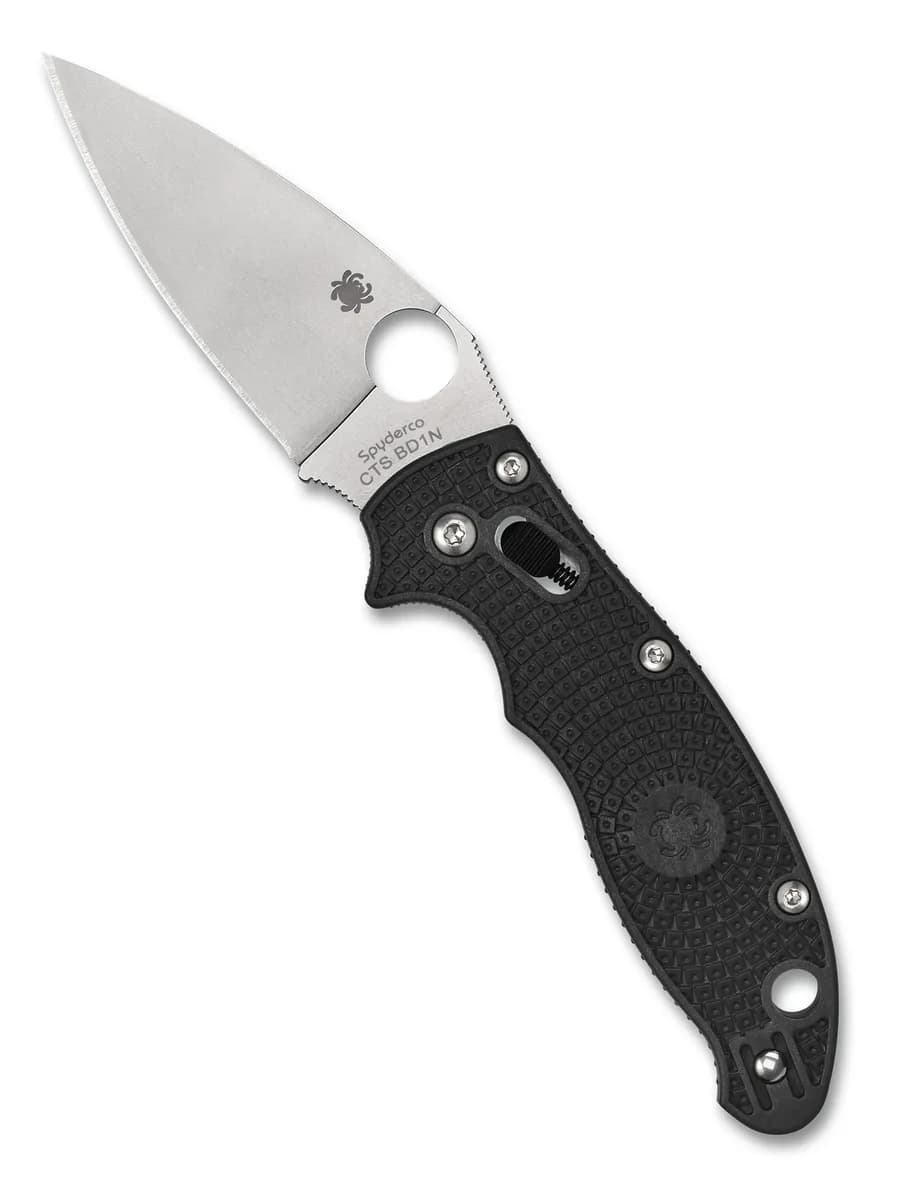
Spyderco Manix 2 Lightweight
The Spyderco Manix 2 Lightweight is a 3.37" drop point folder in CTS-BD1N, full flat ground. The handle is FRCP, secured by a ball bearing lock. Its Ball Bearing lock is rare here — no other folder in the catalogue uses one.
- Blade
- 3.37″
- Weight
- 3 oz
- Steel
- CTS-BD1N
- Price band
- Premium
Everyday carry and general utility
We may earn a commission. Price and availability on Amazon’s site may differ.
Specifications
Manufacturer-published figures, cross-checked against spyderco.com, knifeworks.
- Blade length
- 3.37″
- Spine thickness
- 0.125″
- Blade shape
- Drop Point
- Grind
- Full Flat
- Steel
- CTS-BD1N
- Overall length
- 8.03″
- Closed length
- 4.66″
- Weight
- 3 oz
- Lock
- Ball Bearing
- Deployment
- Manual
- Handle material
- FRCP
- Country of origin
- USA
Why a drop point
The default hunting and EDC shape, and the safest general answer. The spine curves down to the tip in a convex line, which keeps the point low and strong and leaves plenty of belly for skinning. It is hard to make a drop point bad at anything.
Every drop point here →About CTS-BD1N
Nitrogen-enriched BD1. Sharpens very easily and resists rust well — a sensible steel for a knife you actually use hard.
1-5 is a relative ranking drawn from published composition and hardness, not a lab measurement. Higher is better on every axis, and no steel is a 5 across the board — edge retention and toughness pull against each other. All CTS-BD1N knives
What owners say
Drawn from 740 owner discussions of the Spyderco Manix 2 Lightweight since 2024. The opinions are theirs. The specifications above come from the maker.
What owners like
- At 3.0 oz on FRCP it carries lighter than its size suggests: one owner says it rides better in the pocket than a Para 3 because it lacks the aggressive thumb ramp, and another has forgotten it in a pocket and sent it through the wash.
- Long service is on record: one owner on a fire department and ambulance crew has carried theirs at work for about eight years, says it is close to new apart from slight dulling at the tip, and likes that it does not look tactical when pulled out on scene.
- The unlined scales are stiffer than they look; two owners describe the FRCP as rigid for its weight with minimal flex, one finds the directional texture grippy, and another found it incredibly solid in use as long as it is not abused.
- BD1N on this model gets praise for upkeep: one owner says it strops nicely, takes a razor edge and has given them zero complaints alongside smooth action.
- The ball bearing lock runs on a coil spring rather than omega springs, which one owner who has broken several omega springs on other knives sees as the more durable design.
- Current screw-built versions are easy to strip and keep: one owner has carried theirs daily for three years, taken it fully apart twice for cleaning, and never had a screw back out without thread locker.
- A large parts market turns it into a project knife; owners fit aluminium scales, ceramic balls, lighter springs and deep-carry clips, and one says the result feels like a different knife.
- Ergonomics win over lighter rivals for some: one owner says it pushed an S90V Benchmade Bugout out of their pocket with far better handling and grippy scales that still slide smoothly under the clip.
What owners flag
- Out of the box the lock is often very stiff: one owner describes blistered fingers, another a ball lock digging into the finger after a few closes, one a cage stickier than their G10 Manix, and one owner of several says they can be extremely tight new.
- Moving the clip can fail because the clip-screw barrel spins in the FRN; several owners hit this on new knives, and one got a replacement knife from the store under warranty over it.
- The plastic feel puts some people off: one owner says their LW scales feel cheap and flex badly, another rates the unlined FRCP as cheaper-feeling than the lined Sage 5 LW, and a third much prefers the G10 version.
- Aftermarket metal ball cages often bind in LW scales: one owner's cage froze the action, another failed to reassemble it five times, and one had to file the handle before one would fit, while another owner calls reassembly the only real complaint they have.
- Older riveted LW knives cannot be opened without grinding the rivet heads: one owner who tried to remove the rivets destroyed the FRN scales, and another destroyed the FRCP scales getting the hardware out for a scale swap.
- On some LW knives the closed tip sits close to the edge of the scales; one owner cut a finger on it and had it snag a pocket, and Spyderco ground back the choil when the knife was sent in.
- Lighter springs are a trade: one owner found a light aftermarket spring so soft the detent was nearly gone and settled on a medium-strength spring instead.
- BD1N is modest on paper: one hardness test of a DLC-coated BD1N Manix 2 LW read 57.8 HRC.
- Fakes reach buyers through marketplaces; one owner ordering a second Manix 2 LW from a third-party Amazon seller received a near-identical copy, and another bought one on eBay already listed as fake.
Eight years on a fire department and ambulance crew is one owner's record with it, and that owner says the knife is still close to new. People pick the Manix 2 Lightweight as a working folder that weighs 3.0 oz with a 3.37 in blade and carries a wire clip, and one owner likes that it looks friendly enough to use around others. The same knife also comes in a long run of sprint steels, and one owner keeps it in BD1N, Maxamet, 20CV and XHP.
New knives are often very stiff, and owners soften the spring by leaving the blade partly open overnight or longer; one owner went from blistered fingers to very smooth in about two weeks. The unlined FRCP splits opinion, rigid and grippy to some and cheap or flexy to others. Current versions use screws, older ones were riveted shut, and the clip-screw barrel can spin in the plastic when someone tries to move the clip. Scale, cage and spring swaps are common, though one owner had to file the handle to fit a metal cage.
Para 3 Lightweight or Manix 2 LW is the choice one first-time buyer went back and forth on, and another owner says the Manix carries better despite its bigger footprint. Against the G10 Manix 2 the gap is weight: one owner puts a G10 MagnaMax Manix at 143 g against 80.76 g for a BD1N LW and swapped the blade into the lighter knife. A Benchmade Bugout owner moved to it for the handle, while another owner drifted back to a Native 5 LW for its ergonomics.
Is BD1N on the Manix 2 LW good enough, or should I get SPY27?
One owner says BD1N strops nicely, takes a razor edge and has given them no complaints. One hardness test of a DLC-coated BD1N example read 57.8 HRC. One buyer weighing the two found only a $6 price difference.
Will the stiff ball bearing lock loosen up?
Owners say it does. Three owners suggest leaving the blade partly open overnight or longer so the spring takes a set, and one owner who oiled it and worked the blade says it now whips open after years at work. Another owner went from blistered fingers to very smooth in about two weeks.
Is the FRCP handle strong enough without steel liners?
One owner says it feels cheap at first until you use it and find it incredibly solid as long as it is not abused, and another found minimal flex even without steel liners. Not everyone agrees: one owner says their scales feel cheap and flex badly.
Why does the clip screw spin when I try to move the clip?
The D-shaped barrel on the other side can turn in the FRN instead of holding, so the screw never comes out. Owners have hit this on new knives, and one returned theirs through the store under warranty and got a replacement knife.
Can I fit regular Manix 2 scales or a metal ball cage?
Standard Manix 2 scales need a compensated lock backspacer and countersunk screws, with the pivot, washers, ball, cage and spring carried over; one owner's M4 build came to $278 with the backspacer and RSD scales. Metal cages can bind: one froze an owner's action, and another owner recommends sanding the top and bottom on a high-grit stone until it fits. One owner who did the backspacer conversion now has detent lash.
What is the number visible through the ball cage window?
It is the date code from when the knife was made. Many Spydercos carry one, and on the Manix it happens to show through the cage window.
Features
- Ball Bearing lock
- Full Flat grind
- Made in USA
- Stainless blade