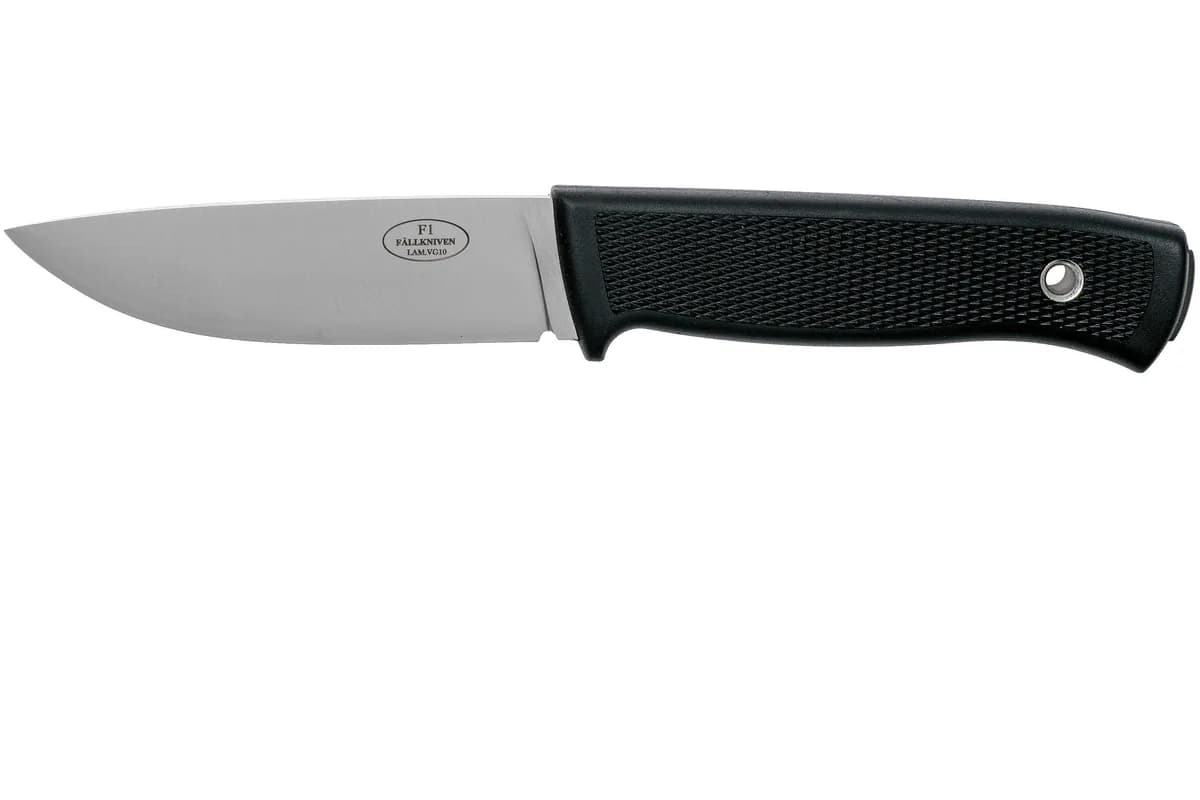
- Fallkniven F1 · Drop Point3.8″ blade · 0.18″ spine · 5.3 oz · ~1.18″ tall
Fallkniven F1
The Fallkniven F1 is a 3.86" drop point fixed blade with a laminated VG7 core, convex ground, on a Thermorun handle. Fallkniven moved it from VG-10 to VG7 without changing the shape, and it weighs 5.3 oz without the sheath.
- Blade
- 3.8″
- Weight
- 5.3 oz
- Steel
- Laminated VG7
- Price band
- Mid
Camp cutting and light carving
We may earn a commission. Price and availability on Amazon’s site may differ.
Specifications
Manufacturer-published figures, cross-checked against knivesandtools, knivesshipfree.
- Blade length
- 3.8″
- Spine thickness
- 0.18″
- Blade shape
- Drop Point
- Grind
- Convex
- Steel
- Laminated VG7
- Overall length
- 8.3″
- Weight
- 5.3 oz
- Lock
- Fixed
- Handle material
- Thermorun
- Country of origin
- Sweden
Why a drop point
The default hunting and EDC shape, and the safest general answer. The spine curves down to the tip in a convex line, which keeps the point low and strong and leaves plenty of belly for skinning. It is hard to make a drop point bad at anything.
Every drop point here →About Laminated VG7
Fällkniven's current core steel, replacing VG-10 in the F1 and A1 from 2025. A Takefu stainless in the same class as VG-10, clad in softer stainless, run at 59 HRC with a convex edge.
1-5 is a relative ranking drawn from published composition and hardness, not a lab measurement. Higher is better on every axis, and no steel is a 5 across the board — edge retention and toughness pull against each other. All Laminated VG7 knives
What owners say
Drawn from 63 owner discussions of the Fallkniven F1 since 2024. The opinions are theirs. The specifications above come from the maker.
What owners like
- The sheath earns real praise: one owner who compared it with the Victorinox Venture's updated sheath calls the F1's plastic sheath the best they have come across, as carefully designed as the knife itself, and another user points out its secondary retention lever, which makes the knife impossible to pull out once it is turned.
- Batoning and splitting suit it: an owner of both the F1 and a Victorinox Venture says the F1 is better at batoning and splitting, and that its convex grind makes up for much of its 4.5 mm thickness.
- Large hands fit it well: two owners who also own White River knives say the F1 handle fills their hand better than the Ursus Cub, one of them having tried hard to like the Cub before finding its grip too small.
- The 3.8 in blade covers most outdoor jobs for some owners: one says that for 99 percent of their camping and hiking needs they prefer something in the 3 to 4 in range like their F1, and another keeps it as their belt knife alongside a saw or hatchet, a BK9 chopper and a pocket folder.
- Owners keep it as a go-to fixed blade: one lists it with their White River and Bradford knives, another with a Mora Companion, and an owner of both the F1 and a Mora Garberg calls the F1 the nicer knife.
- It is built as a survival knife first: one owner notes it was designed for the Swedish air force, and in a rundown of military knives another user lists the F1 among the knives Sweden issues alongside Mora models.
What owners flag
- Thickness makes fine slicing clumsy: one owner who uses it as a go-to fixed blade found themselves wanting something thinner for food, and calls delicate food prep with the F1 clumsy next to a Victorinox Venture.
- Sharpening the convex edge has a learning curve: one owner took their F1 to a sharpening shop and got it back with a changed grind, a Fallkniven fan warns buyers they will eventually have to learn convex sharpening, and an Ursus Cub owner counts not having to grind convex as a reason to pick the Cub.
- The Thermorun handle and the sheath draw a direct complaint from one owner of both an F1 and a White River Ursus, who says the Fallkniven handle deteriorates much faster and calls its sheath poor next to the White River's.
- Value is questioned against rivals: one owner of both an F1 and a Mora Garberg puts the Garberg in the same ballpark in most respects, and in a straight F1 versus Ursus Cub question another user called Fallkniven overpriced and the White River more premium at a comparable price.
- Two owners end up carrying something else: one owner of the F1 and a White River Ursus 45 says they carry the Ursus over the F1 every time, and another says a GiantMouse fixed blade is now their most carried, ahead of their F1.
Owners carry the F1 as a go-to fixed blade for camping and hiking, and two describe it as the belt knife in a kit that also holds a saw or hatchet, a chopper or parang and a pocket folder. One owner notes it was designed as a Swedish air force survival knife and says it leans more toward survival than camp use, though they have no problem using it at camp.
In use, one owner who also carries a thin Victorinox Venture finds the F1 better at batoning and splitting, but clumsy for delicate food prep, where they prefer the thinner knife. The plastic sheath splits opinion: one owner calls it the best they have come across, while another calls it garbage next to White River's. The convex edge comes up as a maintenance topic too, with one owner getting their F1 back from a sharpening shop with the grind changed.
In one buyer's F1 versus White River Ursus Cub question, an owner with big hands and another who found the Cub's grip too small preferred the F1 handle, while Ursus supporters pointed to MagnaCut, no convex edge to sharpen and a better sheath at a lower price. A Mora Garberg comes up as the budget alternative that one F1 owner rates close in most respects, and the Venture owner pairs the F1 with that thinner knife for food.
Should I get the Fallkniven F1 or the White River Ursus Cub?
In one buyer's comparison, an owner of both with big hands says the F1 fills the hand better, and another found the Cub's grip too small, while others prefer the Ursus for MagnaCut, no convex edge to sharpen and a better sheath. One owner of both also found the Fallkniven handle deteriorates much faster.
Is the F1's convex edge hard to sharpen?
One owner had a sharpening shop change the grind on their F1 and asked how to fix it, and a Fallkniven fan warns buyers that they will have to sharpen the convex edge eventually, which can be a challenge if they are not familiar with it.
Can the F1 handle food prep as well as wood processing?
It can, but it is better at the wood. One owner who uses it as a go-to fixed blade says it batons and splits better than a Victorinox Venture, while delicate slicing feels clumsy because of the 0.18 in blade, so they reach for the thinner knife for food.
Is the F1 really a military knife?
One owner notes it was designed as a Swedish air force survival knife. In a rundown of military-issued blades, another user lists the F1 among the knives Sweden issues, alongside Mora models.
How good is the F1's stock sheath?
Opinions differ. One owner calls the plastic sheath the best they have come across, and another notes a secondary retention lever that locks the knife in, but an owner who also has a White River Ursus calls the Fallkniven sheath poor by comparison.
Features
- Full fixed tang
- Convex grind
- Made in Sweden
- Stainless blade
Compare the F1
Related knives
More from Fallkniven →
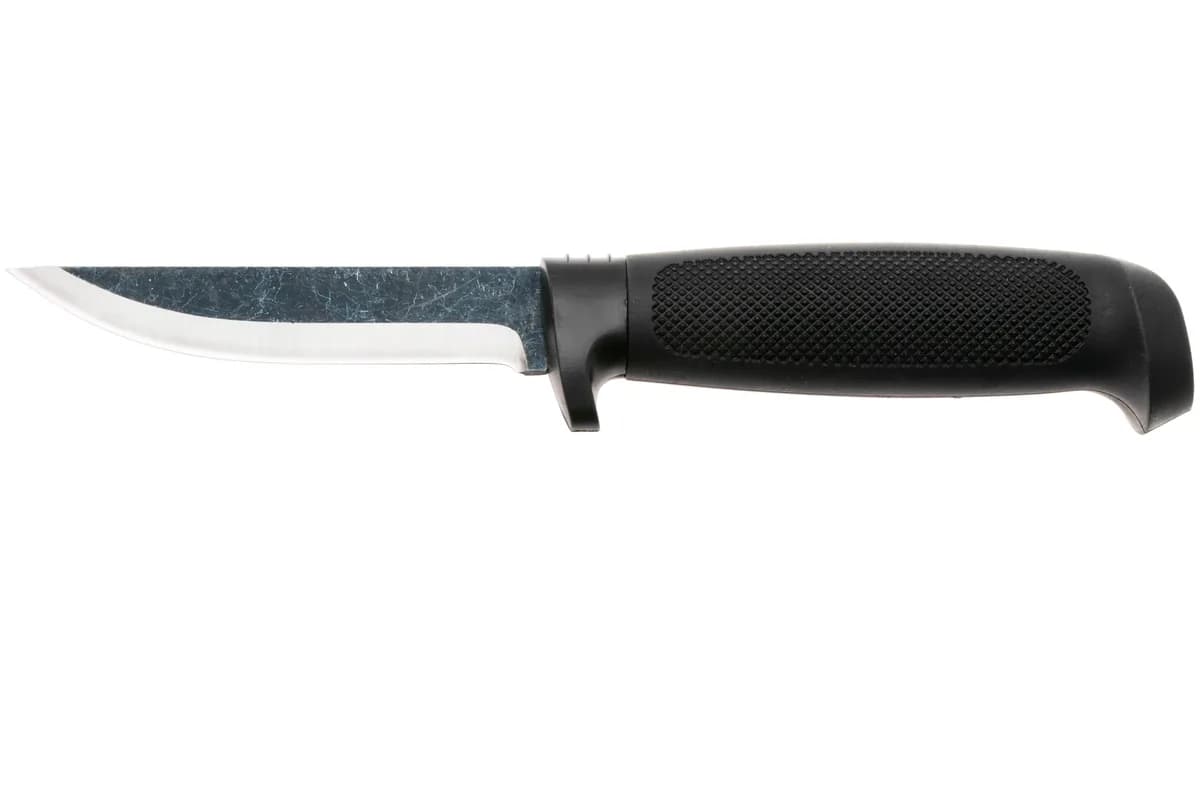
Marttiini Condor Timberjack
- Blade
- 3.75″
- Weight
- 3.25 oz