- ESEE-4 · Drop Point4.5″ blade · 0.188″ spine · 8 oz · 1.25″ tall (published)
ESEE-4
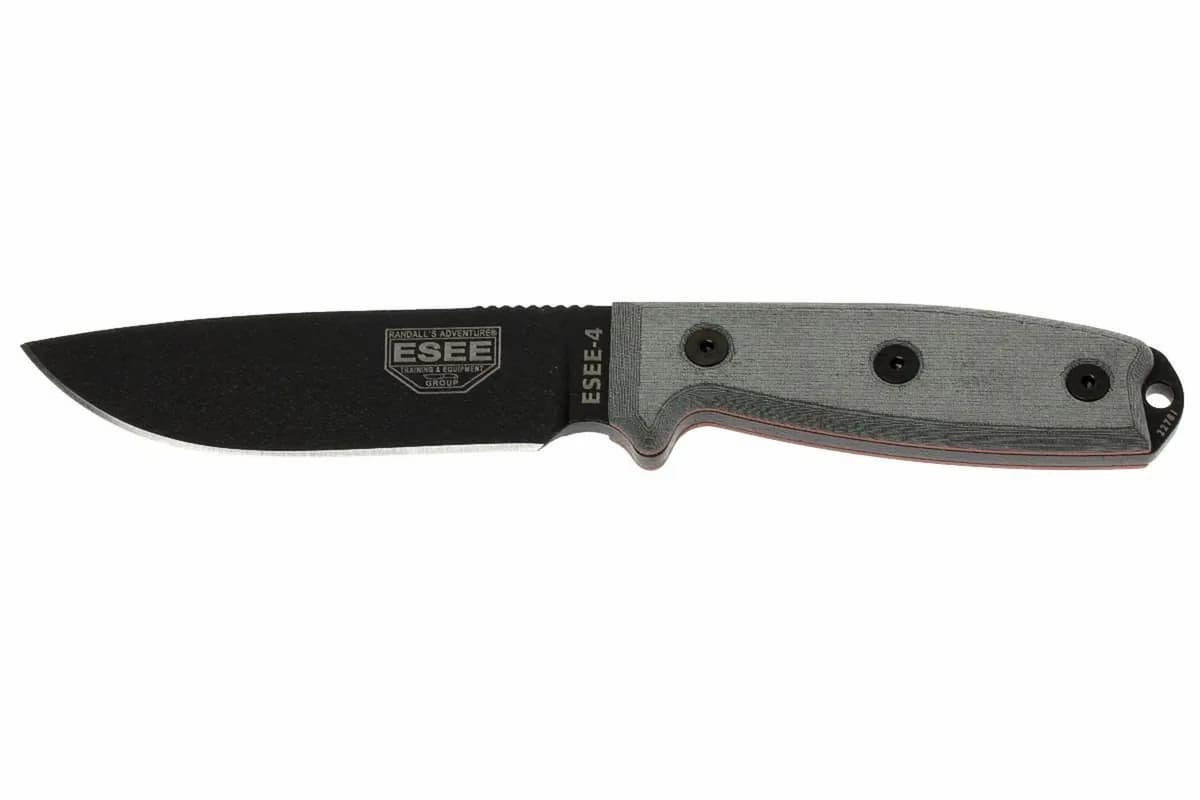
The ESEE-4 is a 4.5" drop point fixed blade in 1095 Carbon, flat ground. The handle is Micarta. At 8 oz it sits 21st-lightest of the 30 bushcraft and camp knives here, where the median is 7.2 oz.
- Blade
- 4.5″
- Weight
- 8 oz
- Steel
- 1095 Carbon
- Price band
- Mid
Batoning, carving and fire prep
We may earn a commission. Price and availability on Amazon’s site may differ.
Specifications
Manufacturer-published figures, cross-checked against eseeknives.com.
- Blade length
- 4.5″
- Cutting edge
- 4.1″
- Spine thickness
- 0.188″
- Blade shape
- Drop Point
- Grind
- Flat
- Steel
- 1095 Carbon
- Weight
- 8 oz
- Lock
- Fixed
- Handle material
- Micarta
- Country of origin
- USA
Why a drop point
The default hunting and EDC shape, and the safest general answer. The spine curves down to the tip in a convex line, which keeps the point low and strong and leaves plenty of belly for skinning. It is hard to make a drop point bad at anything.
Every drop point here →About 1095 Carbon
The American survival-knife standard. Dead simple, very tough at these hardnesses, and it will start rusting the day you put it away wet.
1-5 is a relative ranking drawn from published composition and hardness, not a lab measurement. Higher is better on every axis, and no steel is a 5 across the board — edge retention and toughness pull against each other. All 1095 Carbon knives
What owners say
Drawn from 212 owner discussions of the ESEE-4 since 2024. The opinions are theirs. The specifications above come from the maker.
What owners like
- Long service records: one owner who runs a remote safari lodge in Zambia has carried theirs for 12 years with the coating stripped and a mustard patina, another says it has outlasted half a dozen other fixed blades in their collection, and a forest industrial worker replaced theirs only after beating on it for eight years.
- The warranty is real: one owner's friend broke the owner's six-year-old ESEE-4 trying to free an axe from a log, made a warranty claim, and has a new one on the way, and the warranty is rated up there with A.G. Russell's as about the best around.
- It earns its place as a daily work tool: one field mechanic clears sod around sprinkler heads with it because it cuts precisely without breaking the lines, another owner uses and sharpens theirs every day in rough conditions, and a third keeps theirs in a work bag every day as a workhorse.
- The stock scales fill the hand: one owner of the black version calls them the most comfortable scales they have had on a knife and processed fish without them turning slippery, and another finds that with the jimping it feels right for fine carving and point work.
- The kit comes complete: two Becker BK16 owners point out that the ESEE-4 ships with scales and a hard sheath for around $130, while the BK16 needs aftermarket scales and a sheath to match, and ESEE is credited with better fit, finish and QC.
- Aftermarket scales fix the handle for several owners: one was torn on the knife until fitting contoured scales, another says larger scales turned it from good but annoying into something awesome, and a TKC scale buyer reports a much better feel.
- Plain 1095 takes to modification: owners strip the coating (one used aircraft paint remover), force a patina with vinegar or mustard, and sharpen the spine for a ferro rod, and one who stripped and sharpened theirs calls it the best knife they ever bought.
What owners flag
- The handle runs short: one owner with large-glove hands paid $63 for TKC extended scales on top of a $130 knife, another finds it about half an inch too short, and a BK16 fan despises the handle, even with 3D scales, because the finger choil is too small.
- The stock sheath draws complaints: one owner calls it garbage that rides too high on the belt, another found the belt clip screw holes will not line up for horizontal scout carry, and a several-year owner has no good way to mount it to gear.
- 1095 needs care in wet work: one owner found other tools rusted after a wet 48-hour irrigation shift and cleaned off the ESEE-4 too, the advice being a light coat of oil or the S35VN version, and one well-used carbon ESEE-4 had picked up a bit of rust.
- It is thick for slicing and fussy to sharpen: one owner cannot get their 1095 ESEE-4 to shave arm hair on a sharpener that easily does a Cruwear Adamas, and the thick stock, a 20-degree factory bevel and 56-58 HRC make a stubborn burr the likely cause; another owner prefers the thinner ESEE-3 for slicing.
- The finish invites mods rather than winning fans: one owner hates the coating and stripped it to bare metal, others strip it to get a patina, and one asks why ESEE leaves the spine unsharpened on an outdoor knife meant for ferro rods.
- Price has climbed: one buyer in 2026 says 1095 with G10 should be under $100 and paid $130, another remembers it at $80 to $90, and buyers in Europe and Australia report about 180 euros and $270 AUD.
- Counterfeits circulate secondhand: one buyer paid about $50 for a used ESEE-4 that turned out to be a fake, given away by no serial number, a rougher finish than the real one and slightly off handle screws.
Twelve years of service is the kind of record ESEE-4 owners post. The 4.5 in 1095 blade has been carried for 12 years by one owner who runs a safari lodge in Zambia, used by a field mechanic to dig sod around sprinkler heads, and beaten on for eight years by a forest worker before being replaced. When one does break, the warranty covers it: one owner's friend snapped one trying to free an axe and has a replacement coming.
A short handle is the most common practical complaint. Owners with large hands buy TKC extended or contoured scales, and several say that change made the knife. The stock sheath is the other frequent upgrade, criticized for riding high and for clip holes that do not allow scout carry. The 0.188 in stock with a 20-degree factory bevel makes it a sturdy rather than slicey cutter, and one owner struggled to get theirs hair-shaving sharp. 1095 also needs care in wet work: one owner cleaned theirs after a wet 48-hour irrigation shift and was pointed toward the S35VN version.
The Ka-Bar Becker BK16 is the rival owners weigh most, and the ESEE-4 gets credit for its included scales and sheath, fit and finish and warranty, while one BK16 owner prefers its handle and harder temper. The Mora Garberg comes up as the alternative in head-to-head questions, and one owner who started with a 45 euro Mora Bushcraft Black moved up to the ESEE-4 and no longer sees a reason to use the Mora. Owners who want more corrosion resistance or better slicing look at the S35VN ESEE-4 or the thinner ESEE-3.
Why won't my ESEE-4 get hair-shaving sharp?
One owner hit exactly this with a sharpener that works fine on a Cruwear Adamas. The ESEE-4's 1095 is hardened to 56-58 HRC, which tends to leave a stubborn burr, on thick stock with a 20-degree factory bevel. Raising a burr and then fully removing it is the fix, and another owner finds theirs super easy to sharpen.
Is the stock sheath good enough?
Owners are lukewarm. One calls it garbage and says the clip makes it ride too high, another found the clip holes will not line up for horizontal scout carry, and a long-term owner never found a good way to mount it. Owners carry theirs in aftermarket kydex or homemade leather, but wider aftermarket scales may need the stock sheath heated to fit.
1095 or S35VN?
The 1095 needs care if left wet, and an owner who worked a wet 48-hour irrigation shift was pointed to oiling it or buying the S35VN version. The S35VN is not rustproof either: one owner found theirs corroded more readily than expected. One owner of both versions would not pick the S35VN for a lot of batoning.
ESEE-4 or Becker BK16?
The ESEE-4 gets the nod for better fit, finish and QC, a warranty that ESEE is not known to have denied, and scales and a hard sheath included at around $130. One BK16 owner counters that its handle fits an XL-glove hand without a choil and its harder temper holds an edge longer. Another BK16 owner stripped its factory coating, calling it a bumpy mess.
Will ESEE replace a broken ESEE-4?
Yes. One owner's friend broke the knife while using it to free a stuck axe, made a warranty claim, and was getting a new ESEE-4 shipped. The warranty is rated up there with A.G. Russell's as about the best around.
How can I spot a fake ESEE-4?
One buyer paid about $50 for a used ESEE-4 that was a counterfeit. The giveaways were no serial number, a rougher finish than the real thing and slightly off handle screws. Buying expensive knives only from legitimate retailers avoids it, and ESEE wants to hear who is selling fakes.
Features
- Full fixed tang
- Flat grind
- Made in USA
- Carbon steel blade — will patina
Compare the ESEE-4
Related knives
More from ESEE →