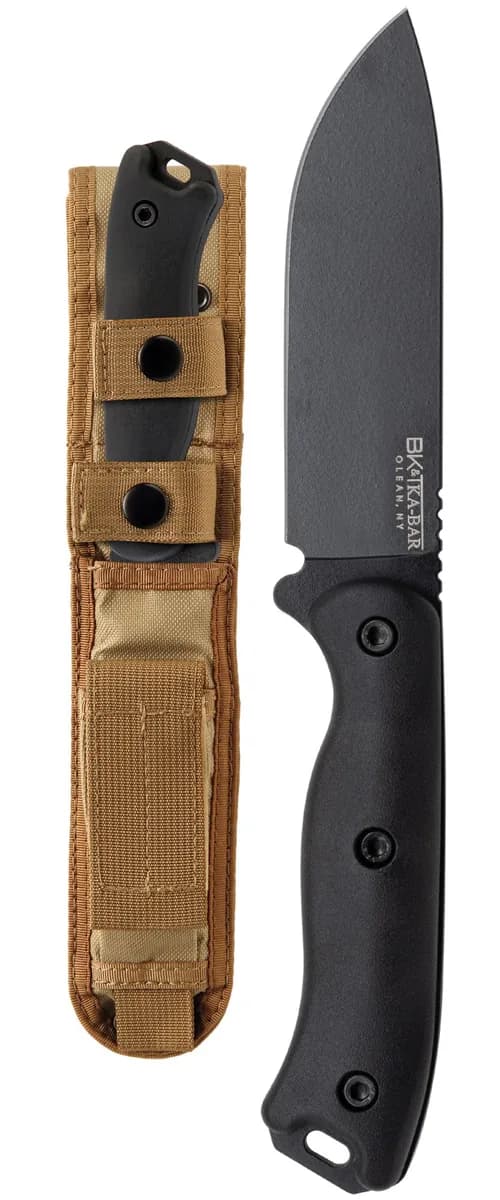
- Ka-Bar Becker BK16 · Drop Point4.375″ blade · 0.17″ spine · 6.4 oz · ~1.34″ tall
Ka-Bar Becker BK16
The Ka-Bar Becker BK16 is a 4.375" drop point fixed blade in 1095 Cro-Van, flat ground. The handle is Zytel. At 6.4 oz it sits 14th-lightest of the 30 bushcraft and camp knives here, where the median is 7.2 oz.
- Blade
- 4.375″
- Weight
- 6.4 oz
- Steel
- 1095 Cro-Van
- Price band
- Premium
Batoning, carving and fire prep
We may earn a commission. Price and availability on Amazon’s site may differ.
Specifications
Manufacturer-published figures, cross-checked against kabar.com, bladehq.
- Blade length
- 4.375″
- Spine thickness
- 0.17″
- Blade shape
- Drop Point
- Grind
- Flat
- Steel
- 1095 Cro-Van
- Overall length
- 9.125″
- Weight
- 6.4 oz
- Lock
- Fixed
- Handle material
- Ultramid
- Country of origin
- USA
Why a drop point
The default hunting and EDC shape, and the safest general answer. The spine curves down to the tip in a convex line, which keeps the point low and strong and leaves plenty of belly for skinning. It is hard to make a drop point bad at anything.
Every drop point here →About 1095 Cro-Van
Ka-Bar's 1095 with chromium and vanadium added — a little more wear resistance, still very much a carbon steel.
1-5 is a relative ranking drawn from published composition and hardness, not a lab measurement. Higher is better on every axis, and no steel is a 5 across the board — edge retention and toughness pull against each other. All 1095 Cro-Van knives
What owners say
Drawn from 41 owner discussions of the Ka-Bar Becker BK16 since 2024. The opinions are theirs. The specifications above come from the maker.
What owners like
- Gets carried more than the ESEEs it is compared with: one owner carries their BK16 far more than an ESEE 3 and credits it with better edge holding and a better handle, and another who has owned many Beckers likes it more than the ESEE 3 and 4
- Lighter and better balanced in hand than an ESEE, according to one owner whose ESEE turned handle heavy to the max after G10 scales went on
- The full flat grind makes it an all-rounder: one owner has used it many times camping and hunting, another finds the straight edge lends itself to woodwork and feather sticks, and one with several Moras carries the BK16 a lot more for general use
- It rides along as the camp knife: one owner pairs it with a Fiskars hatchet, another keeps it lashed to a hiking bag, and another takes it on backcountry camping trips
- It won over one skeptic: an owner who resented the cost of adding micarta scales and a sheath took it to the Rocky Mountains and came back calling it a good choice if limited to one knife
- The stock Zytel fills the hand: one owner calls the scales among the most comfortable they have used and processed fish with them without slipping
What owners flag
- The black coating drags: one owner calls the old thick, bumpy powder coat trash and sanded it off, and others say it adds friction when carving or splitting, though one notes Ka-Bar switched to a thinner coat years ago
- The factory edge is coarse: one new owner found it relatively dull next to a freshly sharpened Mora, and a long-time Becker owner says Becker edges come at around 320 to 400 grit and every one needed honing
- The stock handle splits opinion: one owner found the grips so thin and insecure that they hated the knife until custom scales went on, and others call the Becker handles slippery or cheap feeling
- Plan on spending more on it: two owners count the cost of micarta scales and a better sheath, and one person calls $200 too much for a BK16 with that sheath
- Its flat grind will not carve notches like a scandi: one owner who has used a BK16 many times says the scandi will almost always work better for notches and wood, and the BK16 will not bite the wood quite the same way
- Stripping the coating exposes the jimping, which tears up one owner's thumb without gloves; another ground the jimping off with a bench grinder
- One owner who sharpened theirs to a thin angle found the 1095 chips too easily
A 4.375 inch flat-ground drop point, the BK16 is a mid-size camp blade. Owners carry it on backcountry trips and for camping and hunting, one pairs it with a hatchet, and one owner carries it far more than an ESEE 3 while another likes it more than the ESEE 3 and 4.
1095 Cro-Van under a black coating is where the work comes in. Owners strip the thick coating, hone the coarse factory edge and swap the thin Zytel for micarta or custom scales, and some add a better sheath, which adds to the price. The stock handle divides people: one owner finds it among the most comfortable they own, while others call it slippery and thin.
The ESEE 4 is the main rival, credited with better fit, finish and warranty, while BK16 owners point to lighter weight, better balance and a handle without the ESEE's forward choil. Against a Mora, one owner keeps the Moras for dedicated wood carving and carries the BK16 for everything else, and one owner finds it more practical than the BK2 for general camping and hiking.
BK16 or ESEE 4?
Owners who have had both lean BK16 for carry: one says it holds an edge better and the handle suits them, and another likes it more than the ESEE 3 and 4. ESEE gets the nod for fit, finish and its warranty. One owner points out the ESEE 4's forward finger choil gets uncomfortable when choking up to carve notches.
Why does my new BK16 feel duller than my Mora?
Partly the edge and partly the grind. One long-time Becker owner says Beckers ship with a coarse 320 to 400 grit edge and need honing, and the BK16's flat grind will not bite wood like a scandi. One owner says it still works wood well with a better edge, just at different angles of attack.
Should I strip the coating?
One owner who scraped and sanded off the old thick coating calls it trash that hurt performance, and has had no rust problems with care in a hot, humid climate. Ka-Bar reportedly moved to a thinner coat years ago. One owner who stripped a BK16 does not regret it, but the exposed jimping tears up that owner's thumb without gloves.
Is 1095 still worth buying today?
Yes, with basic care: 1095 holds an edge, takes a beating and throws sparks off a ferro rod, but rusts if it is not kept clean and dry. One owner warns it works best at thicker edge angles, since their BK16 chips too easily after being sharpened thin.
BK16 or BK2?
One owner says the BK16 shares some traits with the BK2 but is flat ground with a more ergonomic handle, which makes it more practical for general camping and hiking.
Features
- Full fixed tang
- Flat grind
- Made in USA
- Carbon steel blade — will patina
Compare the BK16
Related knives
More from Ka-Bar →Ka-Bar Becker BK62 Kephart
- Blade
- 5.125″
- Weight
- 6.4 oz
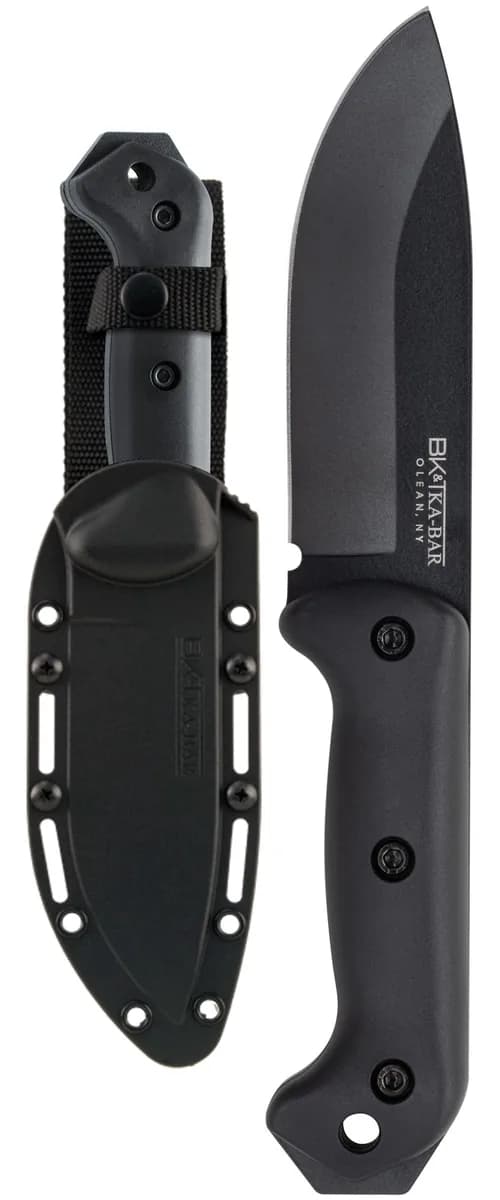
Ka-Bar Becker BK2 Campanion
- Blade
- 5.25″
- Weight
- 15.9 oz